Advertisements
Advertisements
प्रश्न
A student traces the path of a ray of light through a triangular glass prism for different values of angle of incidence. On analyzing the ray diagrams, which one of the following conclusions is he likely to draw?
(A) The emergent ray is parallel to the incident ray.
(B) The emergent ray bends at an angle to the direction of the incident ray.
(C) The emergent ray and the refracted ray are at right angles to each other.
(D) The emergent ray is perpendicular to the incident ray.
Advertisements
उत्तर
(B) The emergent ray bends at an angle to the direction of the incident ray.
In refraction of light through a glass prism, there is deviation or change in the path of light passing through the prism.
APPEARS IN
संबंधित प्रश्न
As light rays emerge from a glass prism into air, are they refracted towards or away from the normal?
Which is optically denser: water or air? Give reason
The diagram below shows the path taken by a narrow beam of yellow monochromatic light passing through an equiangular glass prism. If the yellow light is replaced by a narrow beam of white light incident at the same angle, draw another diagram to show the passage of white light through the prism and label it to show the effect of prism on the white light.

In an experiment to trace the path of a ray of light through a glass prism for different values of angle of incidence a student would find that the emergent ray:
(A) is parallel to the incident ray
(B) perpendicular to the incident ray
(C) is parallel to the refracted ray
(D) bends at an angle to the direction of incident ray
Draw a labeled ray diagram to illustrate the dispersion of a narrow beam of white light when it passes through a glass prism.
If white light is used in same way what change is expected in the emergent beam?
Make the correct choice for each of the following:
Which one of the following Fig correctly shows the path of the ray through the glass block?
Answer the following:
What do you mean by dispersion? Name the different colours of light in the proper sequence in the spectrum of light.
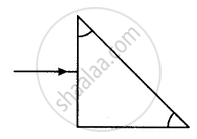
In the diagram, a narrow beam of white light is incident on a right-angled isosceles prism. The critical angle of the material of prism for the yellow colour of white light is 45°. Complete the diagram to show the path of blue, yellow, and red colours of white light till they emerge out of the prism.
During dispersion of white light by prism placed in air, for a particular value of angle of prism,
