Advertisements
Advertisements
प्रश्न
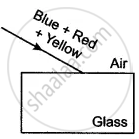
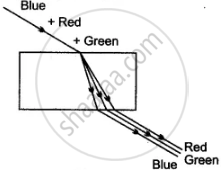
In the figure, a beam of light consisting of three colours blue, red, and yellow is incident on a prism and on a rectangular glass block respectively. Complete the diagram by drawings of the refracted and emergent rays.
Advertisements
उत्तर
The complete diagram is given below:
संबंधित प्रश्न
A narrow beam PQ of white light is passing through a glass prism ABC as shown in the diagram.

Trace it on your answer sheet and show the path of the emergent beam as observed on the screen DE.
(i) Write the name and cause of the phenomenon observed.
(ii) Where else in nature is this phenomenon observed?
(iii) Based on this observation, state the conclusion which can be drawn about the constituents of white light.
Study the following ray diagram:
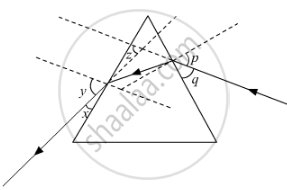
In this diagram, the angle of incidence, the angle of emergence and the angle of deviation respectively have been represented by
(A) y, p, z
(B) x, q, z
(C) p, y, z
(D) p, z, y
How could you show that the colours of the spectrum combine to give white light?
You are given a disc divided into seven sectors with colours violet, indigo, blue, green, yellow, orange and red in them. What would be its colour when it is rotated rapidly?
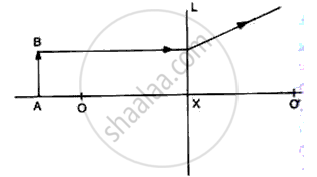
Refer to fig
(i) Name the lens L.
(ii) What are the points O, O' called?
(iii) Complete the diagram to form the image of the object AB.
(iv) Write three characteristics of the image.
Write the range of wavelength of the visible spectrum.
Observe the given figure and write appropriate phenomenon of light in the box.
dispersive power of crown glass? Given that µv = 1.5230, µr = 1.5145
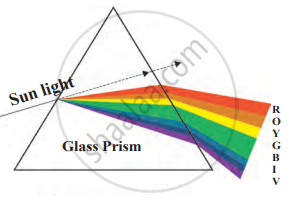
In the following diagram showing dispersion of white light by a glass prism, the colours 'P' and 'Q’ respectively are:

