Advertisements
Advertisements
प्रश्न
Observe the given diagram and answer the questions:
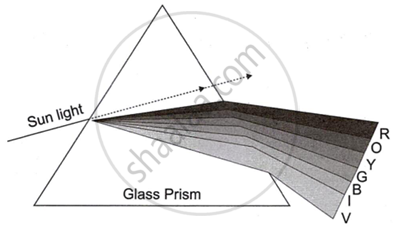
- Name the process shown in the figure.
- Name the colour that deviates the most.
- Name the colour that deviates the least.
- Name any one phenomenon in nature which is based on the above process.
- Define ‘spectrum’.
Advertisements
उत्तर
- The process shown in the figure is the dispersion of light.
- The colour that deviates the most is violet.
- The colour that deviates the least is red.
- One phenomenon in nature based on the above process is the formation of a rainbow.
- A spectrum is a band of colours, as seen in a rainbow, produced by the separation of the components of light by their different degrees of refraction according to wavelength.
APPEARS IN
संबंधित प्रश्न
In the following diagram, the path of a ray of light passing through a glass prism is shown:
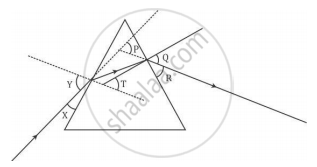
In this diagram the angle of incidence, the angle of emergence and the angle of deviation respectively are (select the correct option):
(A) X, R and T
(B) Y, Q and T
(C) X, Q and P
(D) Y, Q and P
Study the following figure in which a student has marked the angle of incidence (∠i), angle of refraction (∠r), angle of emergence (∠e), angle of prism (∠A) and the angle of deviation (∠D). The correctly marked angles are
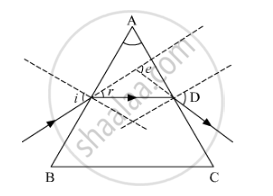
(a) ∠A and ∠i
(b) ∠A, ∠i and ∠r
(c) ∠A, ∠i, ∠e and ∠D
(d) ∠A, ∠i, ∠r and ∠D
State the cause of dispersion of white light
Make two diagrams to explain refraction and dispersion.
What acts as tiny prisms in the formation of a rainbow?
The colour of white light which is deviated the maximum on passing through the glass prism is:
(a) blue
(b) indigo
(c) red
(d) orange
The coloured light having the maximum speed in glass prism is ______.
Which of the following colour of white light has the least wavelength?
(a) red
(b) orange
(c) violet
(d) blue
Why do you not see a spectrum of colours when light passes through a flat pane of glass?
The splitting of white light into its constituent colours is called .............
- A beam of monochromatic light undergoes minimum deviation through an equiangular prism, how does the beam pass through the prism, with respect to its base?
- If white light is used in the same way as in part (a) above, what change do you expect in the emergent beam?
- What conclusion do you draw about the nature of white light in part (b)?
Draw a labelled diagram: Dispersion of light through a prism.
Answer the following:
What do you mean by dispersion? Name the different colours of light in the proper sequence in the spectrum of light.
Sunlight entering through a narrow aperture falls on a prism. Draw a neat labelled ray diagram to show the formation of the spectrum on a screen. Name the colour obtained nearer the base of the prism.
Say TRUE or FALSE
After passing through a prism, white light splits into a band of seven colours
The phenomena of light involved in the formation of rainbow are ______.
Assertion: We can see the rainbow in the sky when the rain starts falling after a spell of bright sunlight.
Reason: The rainbow is formed due to the dispersion of light.
dispersive power of crown glass? Given that µv = 1.5230, µr = 1.5145
When sunlight passes through water droplets in the atmosphere it gets dispersed into its constituent colours forming a rainbow. A similar phenomenon is observed when white light passes through a prism.
Which colour will show the maximum angle of deviation and which colour will show the minimum angle of deviation?
