Advertisements
Advertisements
Question
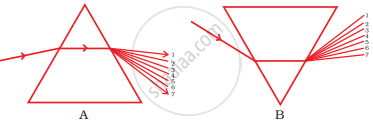
Observe the given diagram and answer the questions:
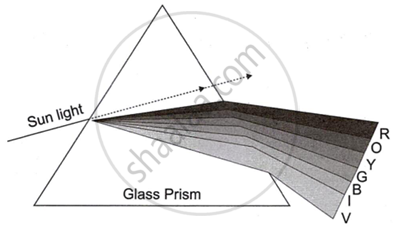
- Name the process shown in the figure.
- Name the colour that deviates the most.
- Name the colour that deviates the least.
- Name any one phenomenon in nature which is based on the above process.
- Define ‘spectrum’.
Advertisements
Solution
- The process shown in the figure is the dispersion of light.
- The colour that deviates the most is violet.
- The colour that deviates the least is red.
- One phenomenon in nature based on the above process is the formation of a rainbow.
- A spectrum is a band of colours, as seen in a rainbow, produced by the separation of the components of light by their different degrees of refraction according to wavelength.
APPEARS IN
RELATED QUESTIONS
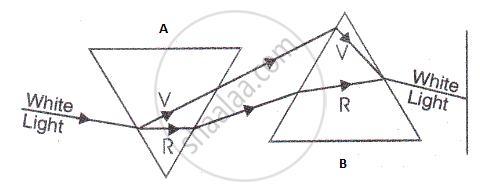
Describe an activity to show that colours of white light splitted by a glass prism can be recombined to get white light by another identical glass prism. Also draw ray diagram to show the recombination of the spectrum of white light.
After tracing the path of a ray of light through a glass prism a student marked the angle of incidence (∠i), angle of refraction (∠r) angle of emergence (∠e) and the angle of deviation (∠D) as shown in the diagram. The correctly marked angles are :

(A) ∠i and ∠r
(B) ∠i and ∠e
(C) ∠i, ∠e and ∠D
(D) ∠i, ∠r and ∠e
As light rays emerge from a glass prism into air, are they refracted towards or away from the normal?
What is spectrum?
What acts as tiny prisms in the formation of a rainbow?
Which of the following colour of white light is least deviated by the prism?
(a) green
(b) violet
(c) indigo
(d) yellow
What conclusion do you draw about the nature of white light in part (b)?
In an experiment to trace the path of a ray of light through a triangular glass prism, a student would observe that the emergent ray
(a) is parallel to the incident ray.
(b) is along the same direction of incident ray.
(c) gets deviated and bends towards the thinner part of the prism.
(d) gets deviated and bends towards the thicker part (base) of the prism.
While performing the experiment to trace the path of a ray of light passing through a glass prism, four students marked the incident ray and the emergent ray in their diagrams in the manner shown below. 
(A) I
(B) II
(C) III
(D) IV
Complete the ray diagram given below to show the nature of light produced on the screen.
The completed ray diagram is as shown below:
An object is placed in front of a converging lens and in front of a diverging lens as in fig.
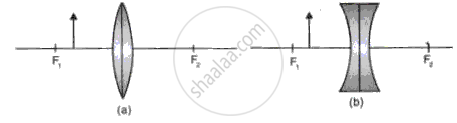
(a)Complete the ray diagram to obtain an image.
(b)Compare the nature of image formed by both the lenses in the above case.
Which characteristic property of light is responsible for the blue colour of the sky?
Write the range of wavelength of the ultraviolet spectrum.
Write the range of wavelength of the infrared spectrum.
The process of separation of light into its component colours while passing through a medium is called _______.
Observe the given figure and write appropriate phenomenon of light in the box.
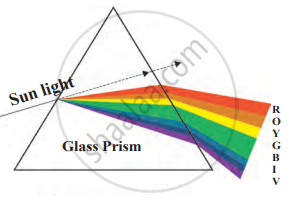
What is dispersion? Explain in detail.
State the correct sequence (1-7) of colours in the spectrum formed by the prisms A and B, shown in the following figure.
dispersive power of crown glass? Given that µv = 1.5230, µr = 1.5145
A prism of refractive index `sqrt2` and refracting angle A produces minimum deviation δm of a ray on one face at an angle of incidence 45°, The values of A and δm are, respectively ______.
