Advertisements
Advertisements
प्रश्न
What is dispersion? Explain in detail.
Advertisements
उत्तर
- Splitting white light into its seven constituent colours (wavelength), on passing through a transparent medium is known as dispersion of light.
- Dispersion occurs because the light of different colours present in white light have different wavelength and they travel at different speeds in a medium.
- The refraction of a light ray in a medium depends on its speed.
APPEARS IN
संबंधित प्रश्न
In the formation of spectrum of white light by a prism:
- which colour is deviated least?
- which colour is deviated most?
Why do you not see a spectrum of colours when light passes through a flat pane of glass?
State the speed of light in (a) air, (b) water, and (c) glass
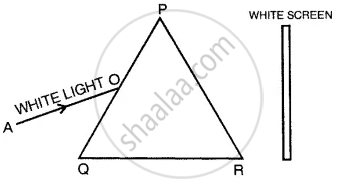
In figure AO is the ray of white light falling on a prism PQR. Complete the diagram till the light emerges out from the prism and falls on the screen.
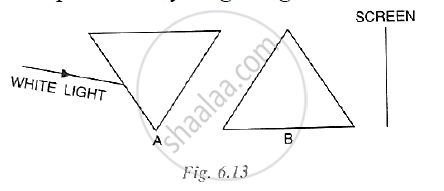
Complete the ray diagram given below to show the nature of light produced on the screen.
Draw a labeled ray diagram to illustrate the dispersion of a narrow beam of white light when it passes through a glass prism.
Write an Explanation.
Critical angle
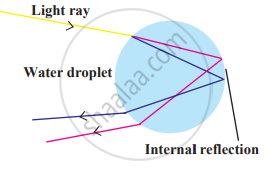
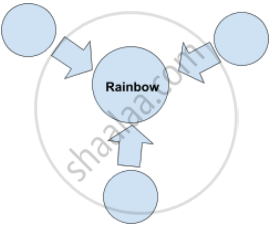
Rainbow is a beautiful natural phenomenon. It is the combined effect of a natural three processes together produced by light. Write it into the circle.
What is Newton’s disc?
State True or False:
"Wavelength of red light is close to 700 nm.”
