Advertisements
Advertisements
प्रश्न
What is dispersion? Explain in detail.
Advertisements
उत्तर
- Splitting white light into its seven constituent colours (wavelength), on passing through a transparent medium is known as dispersion of light.
- Dispersion occurs because the light of different colours present in white light have different wavelength and they travel at different speeds in a medium.
- The refraction of a light ray in a medium depends on its speed.
APPEARS IN
संबंधित प्रश्न
After tracing the path of a ray of light through a glass prism a student marked the angle of incidence (∠i), angle of refraction (∠r) angle of emergence (∠e) and the angle of deviation (∠D) as shown in the diagram. The correctly marked angles are :

(A) ∠i and ∠r
(B) ∠i and ∠e
(C) ∠i, ∠e and ∠D
(D) ∠i, ∠r and ∠e
When a ray of light enters a prism, it bends ______ the normal; as it leaves the prism, it bends ______ the normal.
Draw a diagram to show how white light can be dispersed into a spectrum by using a glass prism. Mark the various colours of the spectrum.
What are the seven colours seen in a rainbow?
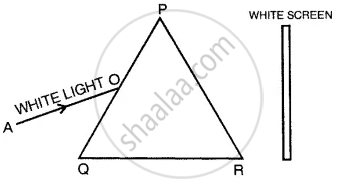
In figure AO is the ray of white light falling on a prism PQR. Complete the diagram till the light emerges out from the prism and falls on the screen.
You are given a disc divided into seven sectors with colours violet, indigo, blue, green, yellow, orange and red in them. What would be its colour when it is rotated rapidly?
An object is placed in front of a converging lens and in front of a diverging lens as in fig.
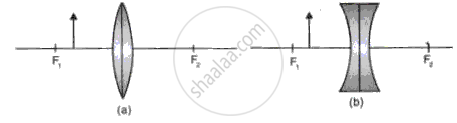
(a)Complete the ray diagram to obtain an image.
(b)Compare the nature of image formed by both the lenses in the above case.
Match the Columns:
| Column ‘A’ | Column ‘B’ |
| The wavelength of red light | (a) 600 nm |
| (b) 700 nm | |
| (c) 500 nm |
Write an Explanation.
Critical angle
When white light enters a glass prism from the air, the angle of deviation is least for ____________.
