Advertisements
Advertisements
Question
The path of a ray of light passing through a glass prism is shown below:
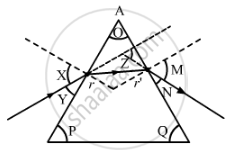
In this diagram, the angle of prism, angle of incidence, angle of emergence and angle of deviation, respectively, have been represented by:
(A) O, Y, Z and N,
(B) P, Y, M and Z,
(C) O, X, M and Z,
(D) P, X, Z and N.
Advertisements
Solution
O is the angle of prism.
Angle of incidence is the angle made by the incident ray with the normal to the surface of the prism. Here, X represents the angle of incidence.
Angle of emergence is the angle made by the emerging ray with the normal to the surface of the prism. Here, Mrepresents the angle of emergence.
Angle of deviation is the angle made by the emerging ray with the incident ray. Here, Z represents the angle of deviation.
Hence, the correct option is C.
APPEARS IN
RELATED QUESTIONS
Draw a ray diagram to explain the term angle of deviation.
How could you show that the colours of the spectrum combine to give white light?
The splitting up of white light into seven colours on passing through a glass prism is called ______.
Out of the following, the colour of light having the maximum wavelength is:
(a) violet
(b) indigo
(c) green
(d) orange
Explain the cause of dispersion of white light through a prism.
A wave has wavelength 50Å of State the speed in vacuum.
Write the range of wavelength of the infrared spectrum.
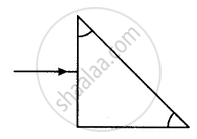
In the diagram, a narrow beam of white light is incident on a right-angled isosceles prism. The critical angle of the material of prism for the yellow colour of white light is 45°. Complete the diagram to show the path of blue, yellow, and red colours of white light till they emerge out of the prism.
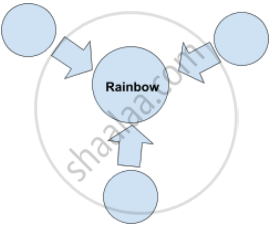
Rainbow is a beautiful natural phenomenon. It is the combined effect of a natural three processes together produced by light. Write it into the circle.
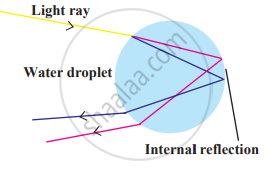
The phenomena of light involved in the formation of rainbow are ______.
