Advertisements
Advertisements
प्रश्न
In the following diagram, the path of a ray of light passing through a glass prism is shown:
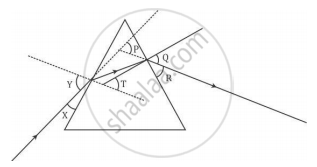
In this diagram the angle of incidence, the angle of emergence and the angle of deviation respectively are (select the correct option):
(A) X, R and T
(B) Y, Q and T
(C) X, Q and P
(D) Y, Q and P
Advertisements
उत्तर
The angle made by the incident ray with the normal to the first face of the prism is called incident angle, which is angle Y here.
The angle made by the emergent ray with the normal to the surface when it comes out from the prism after refraction is called emergent angle, which is angle Q here.
The angle between the incident ray and the emergent ray is called angle of deviation, which is angle P here.
Hence, the correct option is D.
APPEARS IN
संबंधित प्रश्न
Describe an activity to show that colours of white light splitted by a glass prism can be recombined to get white light by another identical glass prism. Also draw ray diagram to show the recombination of the spectrum of white light.
Which is refracted most by a prism : red light or violet light? Explain why?
Name the process which is involved in the formation of a rainbow.
A ray of white light is passed through a glass prism and a spectrum is obtained on a screen.
- Name the seven colours of the spectrum in order.
- Do the colours have the same width in the spectrum?
- Which of the colour of the spectrum of white light deviates (i) the most, (ii) the least?
Complete the ray diagram given below to show the nature of light produced on the screen.
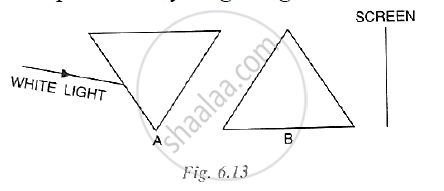
A glass prism is able to produce the spectrum when white light passes through it, but a glass slab doesn’t produce any spectrum. Explain why it is so.
A student has to trace the path of a ray of light through a glass prism. List four precautions he should observe for better results.
What do you understand by spectrum? Name the seven prominent colours in order, as obtained in the spectrum of white light.
Match the Columns:
| Column ‘A’ | Column ‘B’ |
| The wavelength of red light | (a) 600 nm |
| (b) 700 nm | |
| (c) 500 nm |
The splitting of white light into its component colours is called ____________.
