Advertisements
Advertisements
प्रश्न
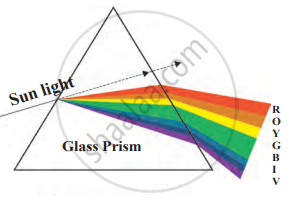
Describe an activity to show that colours of white light splitted by a glass prism can be recombined to get white light by another identical glass prism. Also draw ray diagram to show the recombination of the spectrum of white light.
Advertisements
उत्तर
The seven colours of a spectrum can be recombined to give back white light as
- Two identical glass prisms are placed such that their refracting surfaces are in opposite direction (placed inverted). When a beam of light is allowed to fall on the surface of one prism, a patch of ordinary white light is obtained on a screen placed behind the second prism.
- The first prism disperses the white light into seven coloured rays. The second prism receives all the seven coloured rays from the first prism and recombines them into original white light. This is because the refraction produced by the second prism is equal and opposite to that produced by the first prism. Hence, the light coming out of the second prism will be white

संबंधित प्रश्न
State the cause of dispersion of white light
What will happen if another similar glass prism is placed upside down behind the first prism?
You are given a disc divided into seven sectors with colours violet, indigo, blue, green, yellow, orange and red in them. What would be its colour when it is rotated rapidly?
In the spectrum of white light by a prism, the colour at the extreme end opposite to the base of prism is ______.
The phenomenon of splitting of light into its component colours is ___________ .
Write the range of wavelength of the ultraviolet spectrum.
Sunlight entering through a narrow aperture falls on a prism. Draw a neat labelled ray diagram to show the formation of the spectrum on a screen. Name the colour obtained nearer the base of the prism.
Observe the given figure and write appropriate phenomenon of light in the box.
The splitting of white light in to seven colors is called ______.
The phenomena of light involved in the formation of rainbow are ______.
