Advertisements
Advertisements
प्रश्न
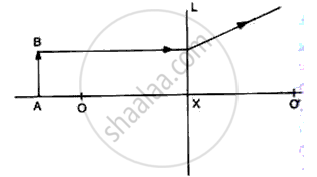
Refer to fig
(i) Name the lens L.
(ii) What are the points O, O' called?
(iii) Complete the diagram to form the image of the object AB.
(iv) Write three characteristics of the image.
Advertisements
उत्तर
(i) concave lens
(ii) Points O and O' are second focus and first focus respectively.
(iii)

(iv) Characteristics of image : erect, dimnished and virtual.
APPEARS IN
संबंधित प्रश्न
What happens when a ray of ordinary light is passed through a triangular glass prism?
When a beam of white light is passed through a prism, it splits to form lights of seven colours. Is it possible to recombine the lights of seven colours to obtain the white light again? Explain your answer.
Name the process which is involved in the formation of a rainbow.
The speed of light in air or vacuum is
A ray of white light is passed through a glass prism and a spectrum is obtained on a screen.
- Name the seven colours of the spectrum in order.
- Do the colours have the same width in the spectrum?
- Which of the colour of the spectrum of white light deviates (i) the most, (ii) the least?
A glass prism is able to produce the spectrum when white light passes through it, but a glass slab doesn’t produce any spectrum. Explain why it is so.
What is the cause of the dispersion of white light through a glass prism? Draw a ray diagram to show the path of light when two identical glass prisms are arranged together in an inverted position with respect to each other and a narrow beam of white light is allowed to fall obliquely on one of the faces of the prisms.
Write the range of wavelength of the infrared spectrum.
The process of separation of light into its component colours while passing through a medium is called _______.
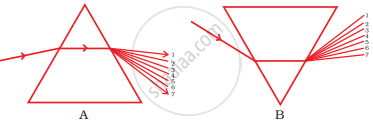
State the correct sequence (1-7) of colours in the spectrum formed by the prisms A and B, shown in the following figure.