Advertisements
Advertisements
प्रश्न
The speed of light in air or vacuum is
पर्याय
3 × 10⁸ M s-1
2.25 × 10⁸ m s-1
332 ms-1
2.0 × 10⁸ ms-1
Advertisements
उत्तर
3 × 10⁸ M s-1
APPEARS IN
संबंधित प्रश्न
State the cause of dispersion of white light passing through a glass prism. How did Newton show that white light of sun contains seven colours using two identical glass prisms. Draw a ray diagram to show the path of light when two identical glass prisms are arranged together in inverted position with respect to each other and a narrow beam of white light is allowed to fall obliquely on one of the focus of the first prism.
Draw a ray diagram to explain the term angle of deviation.
Draw a diagram to show the refraction of light through a glass prism. On this diagram, mark
(i) incident ray
(ii) emergent ray, and
(iii) angle of deviation.
A beam of white light is shone onto a glass prism. The light cannot be:
(a) deviated
(b) dispersed
(c) focused
(d) refracted
You are given a disc divided into seven sectors with colours violet, indigo, blue, green, yellow, orange and red in them. What would be its colour when it is rotated rapidly?
In which of the following four diagrams is the correct path of a ray of light passing through a glass prism shown ?
Distinguish between an impure spectrum and a pure spectrum.
Write the range of wavelength of the visible spectrum.
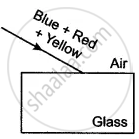
In the figure, a beam of light consisting of three colours blue, red, and yellow is incident on a prism and on a rectangular glass block respectively. Complete the diagram by drawings of the refracted and emergent rays.
Say TRUE or FALSE
After passing through a prism, white light splits into a band of seven colours
