Advertisements
Advertisements
प्रश्न
The process of separation of light into its component colours while passing through a medium is called _______.
पर्याय
reflection of light
refraction of light
dispersion of light
absorption of light
Advertisements
उत्तर
The process of separation of light into its component colours while passing through a medium is called dispersion of light.
APPEARS IN
संबंधित प्रश्न
The path of a ray of light passing through a glass prism is shown below:
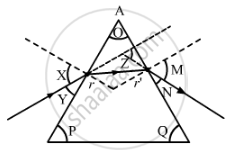
In this diagram, the angle of prism, angle of incidence, angle of emergence and angle of deviation, respectively, have been represented by:
(A) O, Y, Z and N,
(B) P, Y, M and Z,
(C) O, X, M and Z,
(D) P, X, Z and N.
Draw a ray diagram to show the dispersion of white light.
As light rays pass from air into a glass prism, are they refracted towards or away from the normal?
What happens when a ray of ordinary light is passed through a triangular glass prism?
When a beam of white light is passed through a prism, it splits to form lights of seven colours. Is it possible to recombine the lights of seven colours to obtain the white light again? Explain your answer.
Describe how you could demonstrate that white light is composed of a number of colours.
A beam of white light is shone onto a glass prism. The light cannot be:
(a) deviated
(b) dispersed
(c) focused
(d) refracted
The colour of white light which is deviated the maximum on passing through the glass prism is:
(a) blue
(b) indigo
(c) red
(d) orange
Out of the following, the colour of light having the maximum wavelength is:
(a) violet
(b) indigo
(c) green
(d) orange
The splitting of white light into its constituent colours is called .............
Which is optically denser: water or air? Give reason
What do you understand by the term spectrum? Name the various colours present in the spectrum of sunlight.
Define the term dispersion of light.
Draw a labeled ray diagram to illustrate the dispersion of a narrow beam of white light when it passes through a glass prism.
Distinguish between an impure spectrum and a pure spectrum.
Match the Columns:
| Column ‘A’ | Column ‘B’ |
| The wavelength of red light | (a) 600 nm |
| (b) 700 nm | |
| (c) 500 nm |
Write an Explanation.
Critical angle
The splitting of white light in to seven colors is called ______.
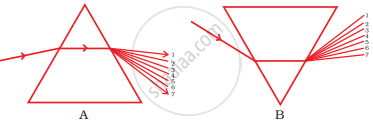
State the correct sequence (1-7) of colours in the spectrum formed by the prisms A and B, shown in the following figure.