Advertisements
Advertisements
प्रश्न
The process of separation of light into its component colours while passing through a medium is called _______.
विकल्प
reflection of light
refraction of light
dispersion of light
absorption of light
Advertisements
उत्तर
The process of separation of light into its component colours while passing through a medium is called dispersion of light.
APPEARS IN
संबंधित प्रश्न
Define the term dispersion of white light.
What happens when a ray of ordinary light is passed through a triangular glass prism?
What acts as tiny prisms in the formation of a rainbow?
The splitting of white light into its constituent colours is called .............
State the speed of light in (a) air, (b) water, and (c) glass
Which is optically denser: water or air? Give reason
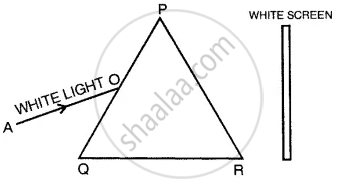
In figure AO is the ray of white light falling on a prism PQR. Complete the diagram till the light emerges out from the prism and falls on the screen.
You are given a disc divided into seven sectors with colours violet, indigo, blue, green, yellow, orange and red in them. What would be its colour when it is rotated rapidly?
Explain the cause of dispersion of white light through a prism.
Explain briefly, with the help of a neat labelled diagram, how white light gets dispersed by a prism. On which surface of a prism, there is both dispersion and deviation of light, and on which surface of the prism, there is only deviation of light ?
- A beam of monochromatic light undergoes minimum deviation through an equiangular prism, how does the beam pass through the prism, with respect to its base?
- If white light is used in the same way as in part (a) above, what change do you expect in the emergent beam?
- What conclusion do you draw about the nature of white light in part (b)?
In an experiment to trace the path of a ray of light through a glass prism for different values of angle of incidence a student would find that the emergent ray:
(A) is parallel to the incident ray
(B) perpendicular to the incident ray
(C) is parallel to the refracted ray
(D) bends at an angle to the direction of incident ray
Make the correct choice for each of the following:
Which one of the following Fig correctly shows the path of the ray through the glass block?
Write the range of wavelength of the ultraviolet spectrum.
Suggest one way, in each case, by which we can detect the presence of Infrared radiations.
The splitting of white light in to seven colors is called ______.
The sunlight can be split into its constituent colors using ______.
Say TRUE or FALSE
After passing through a prism, white light splits into a band of seven colours
Which of the following is a natural phenomenon which is caused by the dispersion of sunlight in the sky?
State the colour which bends:
- The most.
- The least while passing through a glass prism.
