Advertisements
Advertisements
प्रश्न
Light changes its direction when going from one transparent medium to another transparent medium. This is called _______.
विकल्प
Reflection of light
Refraction of light
Dispersion of light
Aabsorption of light
Scattering of light
Advertisements
उत्तर
Light changes its direction when going from one transparent medium to another transparent medium. This is called refraction of light.
Explanation:
- When light travels through a transparent material, like glass or water, it bends, a phenomenon known as refraction.
- This occurs because light travels at various speeds through different optical densities.
APPEARS IN
संबंधित प्रश्न
| Column I | Column II | Column III | |
| 1 | Dispersion | Long-sightedness | Twinkling of stars |
| 2 | Refraction | Splitting of white light into component colours | Convex lens |
| 3 | Hypermetropia | Change in the direction of the ray of light due to change in medium | Spectrum of seven colours |
A ray of light strikes a plane mirror such that its angle of incidence is 30°. What angle does the reflected ray make with the mirror surface?
Write the word AMBULANCE as it would appear when reflected in a plane mirror. Why is it sometimes written in this way (as its mirror image) on the front of an ambulance?
What is the difference between regular reflection of light and diffuse reflection of light?
The image of an object formed by a plane mirror is:
(a) virtual
(b) real
(c) diminished
(d) upside-down
A man stands 10 m in front of a large plane mirror. How far must the walk before he is 5 m away from his image?
Explain how to read the following message which was found on some blotting paper:

A ray of light goes from water into air. Will it bend towards the normal or away from the normal?
Fill in the following blank with suitable word:
Light bends when is passes from water into air. We say that it is ............
A coin in a glass tumbler appears to rise as the glass tumbler is slowly filled with water. Name the phenomenon responsible for this effect.
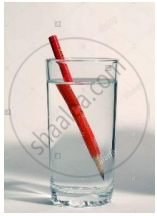
Name the phenomenon due to which a pencil partly immersed in water and held obliquely appears to be bent at the water surface.
Light travelling from a denser medium to a rarer medium along a normal to the boundary:
(a) is refracted towards the normal
(b) is refracted away from the normal
(c) goes along the boundary
(d) is not refracted
A ray of light passes from a medium X to another medium Y. No refraction of light occurs if the ray of light hits the boundary of medium Y at an angle of:
(a) 0°
(b) 45°
(c) 90°
(d) 120°
Light travels at a lower speed in water than in air.
A small air bubble in a glass block when seen from above appears to be raised because of ______.
Choose and write the correct option.
If we gradually increase the angle of incidence of a ray of light passing through prism then …..
List in proper sequence the steps of the experiment for determining the approximate focal length of a given concave mirror by obtaining the image of a distant object.
Due to _______ pencil looks bent in water, in the given experiment.
The refractive index of a transparent medium is always greater than ______.
The angle of incidence for a ray of light having zero reflection angle is ______.
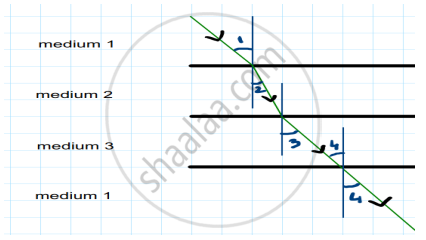
In the above diagram light is travelling through different media. It is noted by a scientist that ∠1= ∠3 = ∠4 but ∠2 < ∠1. Which of the following statement would be correct?
When light passes from one medium to another the ray gets bent. This property of light is called ______.
Light bends as it passes from one medium to another. What is this phenomenon called?
Light travels fastest in a vacuum. Why?
Under what circumstances there won’t be any refraction of light when it enters from one medium to another?
Why a pencil partly immersed in water appears to be bent at the water surface.
How do twinkling stars occur? (or) what is the cause of the twinkling of stars?
A ray of light starting from diamond is incident on the interface separating diamond and water. Draw a labelled ray diagram to show. the refraction of light in this case.
The change in the direction of the path of light when it passes from one transparent medium to another transparent medium is called:
The part of light that enters into the other medium and travels in a straight path but in a direction different from its initial direction is called:
A normal is an imaginary line drawn ________ to the boundary at the point of incidence.
When light travels from a rarer medium to a denser medium, its speed:
When a ray of light is incident along the normal on the surface separating two media:
According to the first law of refraction, the incident ray, the refracted ray, and the normal at the point of incidence:
According to the second law of refraction, for a given pair of media, the ratio of the sine of the angle of incidence to the sine of the angle of refraction:
In the formula for absolute refractive index \[n = \frac{c}{v}\], the quantity c represents:
A medium with a higher refractive index is:
