Advertisements
Advertisements
प्रश्न
The size of image of an object by a convex lens of focal length 20 cm is observed to be reduced to `1/3` rd of its size . Find the distance of the object from the optical centre of the lens .
Advertisements
उत्तर
Given :
`f = 20 "cm" ; ν = 1/3 u "cm" ; u = ?`
we know that ,
`1/f = 1/ν + 1/u`
using sign convensions ,
`1/f = -1/u - 1/ν `
`therefore 1/20 = -1/u - 3/4 = -4/u`
`therefore u = -4 xx 20 = -80 "cm"`
`therefore u = -80 "cm"`
APPEARS IN
संबंधित प्रश्न
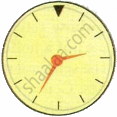
The figure given alongside shows the image of a clock as seen in a plane mirror. The correct time is:
A ray of light passes from air into a block of glass. Does it bend towards the normal or away from it?
State two factors on which the lateral displacement of the emergent ray depends.
A ray of light passes from a medium X to another medium Y. No refraction of light occurs if the ray of light hits the boundary of medium Y at an angle of:
(a) 0°
(b) 45°
(c) 90°
(d) 120°
Fill in the blank and Explain the completed sentences.
The change in ______ of light rays while going from one medium to another is called refraction.
A real image is formed by the light rays after reflection or refraction when they:
- actually meet or intersect with each other.
- actually converge at a point.
- appear to meet when they are produced in the backward direction.
- appear to diverge from a point.
Which of the above statements are correct?
Lights of different colours are used as signal for safety transport. From these, the wavelength of red light is _______ nm.
Explain with diagrams how refraction of incident light takes place from
- rarer to denser medium
- denser to rarer medium
- normal to the surface separating the two media.
A normal is an imaginary line drawn ________ to the boundary at the point of incidence.
A medium with a higher refractive index is:
