Advertisements
Advertisements
Question
The size of image of an object by a convex lens of focal length 20 cm is observed to be reduced to `1/3` rd of its size . Find the distance of the object from the optical centre of the lens .
Advertisements
Solution
Given :
`f = 20 "cm" ; ν = 1/3 u "cm" ; u = ?`
we know that ,
`1/f = 1/ν + 1/u`
using sign convensions ,
`1/f = -1/u - 1/ν `
`therefore 1/20 = -1/u - 3/4 = -4/u`
`therefore u = -4 xx 20 = -80 "cm"`
`therefore u = -80 "cm"`
APPEARS IN
RELATED QUESTIONS
Fill in the following blank with a suitable word:
When light is reflected, the angles of incidence and reflection are ............ .
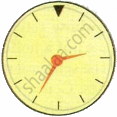
The figure given alongside shows the image of a clock as seen in a plane mirror. The correct time is:
What is meant by the ‘angle of incidence’ for a ray of light?
Image is formed by a mirror due to refraction of light.
Explain the working of a periscope.
A ray of light traveling in medium 1 strikes and travels into another transparent medium 2. If the speed of light is greater in medium 1, the ray will ______.
How do twinkling stars occur? (or) what is the cause of the twinkling of stars?
The ray that enters the second medium after crossing the boundary is called the:
The constant \[\frac{\sin i}{\sin r}\] for a given pair of media is called the:
To a crane, a fish appears 6 cm below the water surface. Taking the refractive index of water as \[\frac{4}{3}\], the real depth of the fish below the surface is:
