Advertisements
Advertisements
प्रश्न
A ray of light strikes a plane mirror PQ at an angle of incidence of 30°, is reflected from the plane mirror and then strikes a second plane mirror QR placed at right angles to the first mirror. The angle of reflection at the second mirror is ______.
विकल्प
30°
45°
60°
90°
Advertisements
उत्तर
A ray of light strikes a plane mirror PQ at an angle of incidence of 30°, is reflected from the plane mirror and then strikes a second plane mirror QR placed at right angles to the first mirror. The angle of reflection at the second mirror is 60°.
संबंधित प्रश्न
| Column I | Column II | Column III | |
| 1 | Dispersion | Long-sightedness | Twinkling of stars |
| 2 | Refraction | Splitting of white light into component colours | Convex lens |
| 3 | Hypermetropia | Change in the direction of the ray of light due to change in medium | Spectrum of seven colours |
A boy with a mouth 5 cm wide stands 2 m away from a plane mirror. Where is his image and how wide is the image of his mouth?
An extended object in the form of an arrow pointing upward has been placed in front of a plane mirror. Draw a labelled ray-diagram to show the formation of its image.
The image of an object formed by a plane mirror is:
(a) virtual
(b) real
(c) diminished
(d) upside-down
State whether the following statement is true or false:
Refraction occurs because light slows down in denser materials.
What is meant by the ‘angle of incidence’ for a ray of light?
Light travels more quickly through water than through glass.
- Which is optically denser: water or glass?
- If a ray of light passes from glass into water, which way will it bend: towards the normal or away from the normal?
Draw suitable diagrams to illustrate how a beam of light incident parallel to the principal axis is reflected by:
(a) a concave mirror, and (b) a convex mirror
A ray of light passes from medium 1 to medium 2. Which of the following quantities of the refracted ray will differ from that of the incident ray: Speed, intensity, frequency, wavelength?
A ray of light A incident from air suffers partial reflection and refraction at the boundary of water.
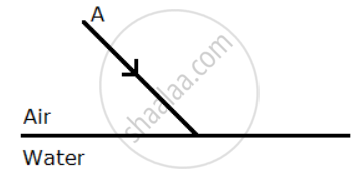
- Complete the diagram showing (i) the reflected ray B and (ii) the refracted ray C.
- How are the angles of incidence i and refraction r related?
Assertion and reasoning type
- Assertion: If the refractive index of the medium is high (denser medium) the velocity of the light in that medium will be small
- Reason: Refractive index of the medium is inversely proportional to the velocity of the light
If a beam of red light and a beam of violet light are incident at the same angle on the inclined surface of a prism from air medium and produce angles of refraction r and v respectively, which of the following is correct?
A pencil when dipped in water in a glass tumbler appears to be bent at the interface of air and water. Will the pencil appear to be bent to the same extent, if instead of water we use liquids like, kerosene or turpentine. Support your answer with reason.
Light bends as it passes from one medium to another. What is this phenomenon called?
The ratio of the sine of the angle of incidence to the sine of ______ is constant.
Twinkling of stars and Mirage are the two phenomena occurring due to refraction.
The bottom of swimming pool appears to be less deep than the actual one because of
The part of light that enters into the other medium and travels in a straight path but in a direction different from its initial direction is called:
When light passes from one transparent medium to another, its direction changes due to:
