Advertisements
Advertisements
प्रश्न
The boy walks towards the mirror at a speed of 1 m/s. At what speed does his image approach him?
Advertisements
उत्तर
The image approaches him at a speed of 2 m/s . The reason being, the image moves at a speed of 1 m/s and
the relative speed of the image will be equal to the sum of the speeds of the image and the boy.
APPEARS IN
संबंधित प्रश्न
State the uses of plane mirrors.
The image in a plane mirror is virtual and laterally inverted. What does this statement mean?
Which phenomenon of light makes the water to appear shallower than it really is?
Explain with the help of a labelled ray diagram, why a pencil partly immersed in water appears to be bent at the water surface. State whether the bending of pencil will increase or decrease if water is replaced by another liquid which is optically more dense than water. Give reason for your answer.
Water is optically denser than glass.
A ray of light when passes from glass to air, bends towards the normal.
Light travels at a lower speed in water than in air.
What is the cause of refraction of light when it passes from one medium to another?
A ray of light A incident from air suffers partial reflection and refraction at the boundary of water.
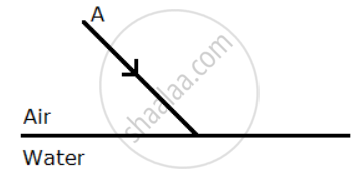
- Complete the diagram showing (i) the reflected ray B and (ii) the refracted ray C.
- How are the angles of incidence i and refraction r related?
Fill in the blank and Explain the completed sentences.
The change in ______ of light rays while going from one medium to another is called refraction.
Write a scientific reason.
The coin disappears in a vessel as it is seen from a specific location. But as soon as the water is poured into the vessel to a certain level, the coin appears.
The refractive index of four substances A, B, C, and D are 1.31, 1.43, 1.33, 2.4 respectively. The speed of light is maximum in
The refractive index of a transparent medium is always greater than ______.
Which surface will not reflect most of the light falling on them?
The bending of light as it passes from one medium to another is called ______.
The ratio of the sine of the angle of incidence to the sine of ______ is constant.
Assertion: The air bubble shines in water.
Reason: Air bubble shines due to the refraction of light.
Which is optically denser out of the two medium M1& M2 having the refractive indices = 1.71 and 1.36 respectively?
Which of the following relations is called Snell's Law?
A medium with a higher refractive index is:
