Advertisements
Advertisements
प्रश्न
An extended object in the form of an arrow pointing upward has been placed in front of a plane mirror. Draw a labelled ray-diagram to show the formation of its image.
Advertisements
उत्तर

APPEARS IN
संबंधित प्रश्न
With the help of a labelled ray-diagram, describe how a plane mirror forms an image of a point source of light placed in front of it. State the characteristics of the image formed in a plane mirror.
A man sits in an optician's chair looking into plane mirror which is 2 m away from him and views the image of a chart which faces the mirror and is 50 cm behind his head. How far away from his eyes does the chart appear to be?
Show the lateral displacement of the ray on the diagram.
The depth of a pond when seen from above appears to be less.
Match the Following
| Column A | Column B |
| (a) white Light | (1) Convex mirror |
| (b) Refraction | (2) Concave mirror |
| (c) Virtual images | (3) refraction |
| (d) Real images | (4) spectrum |
| (e) Prism | (5) ray of light from glass to air |
What is the cause of refraction of light when it passes from one medium to another?
The laws of reflection hold true for ______.
Write scientific reason.
The sun appears on the western horizon for some time after sunset.
Assertion and reasoning type
- Assertion: If the refractive index of the medium is high (denser medium) the velocity of the light in that medium will be small
- Reason: Refractive index of the medium is inversely proportional to the velocity of the light
The deviation of light ray from its path when it travels from one transparent medium to another transparent medium is called ______.
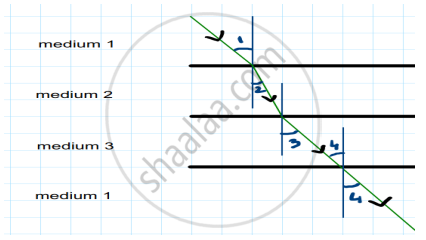
In the above diagram light is travelling through different media. It is noted by a scientist that ∠1= ∠3 = ∠4 but ∠2 < ∠1. Which of the following statement would be correct?
Which object use the reflection of light?
Assertion: The air bubble shines in water.
Reason: Air bubble shines due to the refraction of light.
Under what circumstances there won’t be any refraction of light when it enters from one medium to another?
The change in the direction of the path of light when it passes from one transparent medium to another transparent medium is called:
A normal is an imaginary line drawn ________ to the boundary at the point of incidence.
A medium with a higher refractive index is:
