Advertisements
Advertisements
प्रश्न
State whether the following statement is true of false:
A student says that we can see an object because light from our eyes is reflected back by the object.
Advertisements
उत्तर
False.We can see an object because light, on being reflected from the object, is scattered and diffused.
APPEARS IN
संबंधित प्रश्न
What is the difference between regular reflection of light and diffuse reflection of light?
A man sits in an optician's chair looking into plane mirror which is 2 m away from him and views the image of a chart which faces the mirror and is 50 cm behind his head. How far away from his eyes does the chart appear to be?
In which material do you think light rays travel faster-glass or air?
Why does a ray of light bend when it travels from one medium to another?
A coin in a glass tumbler appears to rise as the glass tumbler is slowly filled with water. Name the phenomenon responsible for this effect.
The depth of a pond when seen from above appears to be less.
Define the principal focus of a concave mirror.
Write scientific reason.
The bottom of a pond appears raised.
Write a scientific reason.
The coin disappears in a vessel as it is seen from a specific location. But as soon as the water is poured into the vessel to a certain level, the coin appears.
Observe the given figure and name the following.
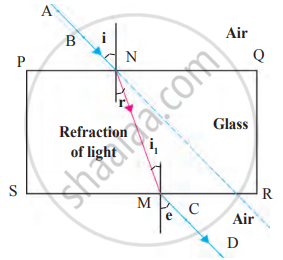
| Ray AB | |
| Ray NM | |
| Ray MD | |
| ∠ r |

The angle of incidence from air to glass at the point O on the hemispherical glass slab is.
Which object use the reflection of light?
A ray of light traveling in medium 1 strikes and travels into another transparent medium 2. If the speed of light is greater in medium 1, the ray will ______.
A star appears twinkling into the sky because of the reflection of light by the atmosphere.
Under what circumstances there won’t be any refraction of light when it enters from one medium to another?
Match the following:
| Column I | Column II | ||
| 1. | r > 90 | a. | Light gazes at the surface of separation between the two modes. |
| 2. | r = 90 | b. | No refraction. |
| 3. | r < 90 | c. | Refracted ray away from the normal |
The ray that enters the second medium after crossing the boundary is called the:
When light travels from a denser medium to a rarer medium, its speed:
According to the first law of refraction, the incident ray, the refracted ray, and the normal at the point of incidence:
In the formula for absolute refractive index \[n = \frac{c}{v}\], the quantity c represents:
