Advertisements
Advertisements
Question
Study the following ray diagram:
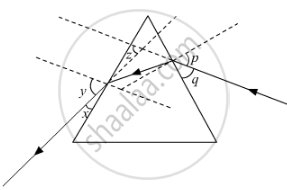
In this diagram, the angle of incidence, the angle of emergence and the angle of deviation respectively have been represented by
(A) y, p, z
(B) x, q, z
(C) p, y, z
(D) p, z, y
Advertisements
Solution
Angle p is the angle of incidence since this angle is formed between the incident ray and the normal.
Angle y is the angle of emergence as it is formed between the emergent ray and the normal.
and angle z is the angle of deviation as it is formed between the emergent ray and the incident ray.
Hence, the correct answer is p, y, z
APPEARS IN
RELATED QUESTIONS
A student traces the path of a ray of light through a triangular glass prism for different values of angle of incidence. On analyzing the ray diagrams, which one of the following conclusions is he likely to draw?
(A) The emergent ray is parallel to the incident ray.
(B) The emergent ray bends at an angle to the direction of the incident ray.
(C) The emergent ray and the refracted ray are at right angles to each other.
(D) The emergent ray is perpendicular to the incident ray.
The path of a ray of light passing through a glass prism is shown below:
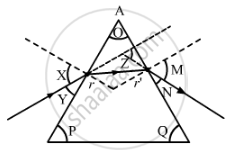
In this diagram, the angle of prism, angle of incidence, angle of emergence and angle of deviation, respectively, have been represented by:
(A) O, Y, Z and N,
(B) P, Y, M and Z,
(C) O, X, M and Z,
(D) P, X, Z and N.
In the formation of spectrum of white light by a prism:
- which colour is deviated least?
- which colour is deviated most?
In the figure given alongside, a narrow beam of white light is shown to pass through a triangular glass prism. After passing through the prism, it produces a spectrum YX on the screen.
Why do different colours of white light bend through different angles with respect to the incident beam of light?
What is a rainbow?
The frequency range of visible light is from 3.75 × 10¹⁴ Hz to 7.5 × 10¹⁴ Hz. Calculate its wavelength range. Take speed of light = 3 × 10⁸ m/s.
A wave has wavelength 50Å of State the speed in vacuum.
Say TRUE or FALSE
After passing through a prism, white light splits into a band of seven colours
A prism of refractive index `sqrt2` and refracting angle A produces minimum deviation δm of a ray on one face at an angle of incidence 45°, The values of A and δm are, respectively ______.
