Advertisements
Advertisements
प्रश्न
What is a rainbow?
Advertisements
उत्तर
A rainbow is a curving optical phenomenon of seven colours caused by the refraction, reflection, and dispersion of sunlight in water droplets. The rainbow is seen as a large area in the sky with many colors.
APPEARS IN
संबंधित प्रश्न
What do you understand by the term spectrum?
The wavelengths of violet and red light are 4000 Å and 8000 Å respectively. Which of the two has the higher frequency?
A wave has wavelength 50Å of State its one use.
Write three conditions necessary to obtain a pure spectrum on a screen. Name the instrument in which the conditions stated by you are fulfilled.
Sunlight entering through a narrow aperture falls on a prism. Draw a neat labelled ray diagram to show the formation of the spectrum on a screen. Name the colour obtained nearer the base of the prism.
In the figure, a beam of light consisting of three colours blue, red, and yellow is incident on a prism and on a rectangular glass block respectively. Complete the diagram by drawings of the refracted and emergent rays.
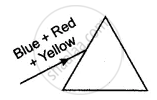
Draw a neat and labelled diagram for dispersion of light.
Observe the given figure and answer the following questions.
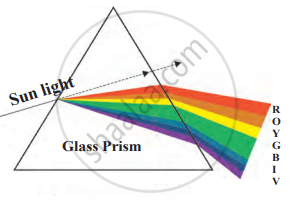
- Which colour light rays bend most?
- Which colour light rays bend least.
- What is the wavelength of violet light rays?
______ colour is deviated the least in the spectrum of white light obtained with a glass prism.
