Advertisements
Advertisements
प्रश्न
Advertisements
उत्तर
Three properties of infrared radiations similar to the visible light:
1. They travel in straight lines as light does, with a speed equal to 3 x 10⁸ m/s in vacuum.
2. They obey laws of reflection and refraction.
3. They are unaffected by electric and magnetic fields.
Two properties of infrared radiation different from the visible light:
1. They are absorbed by glass, but they are not absorbed by rock-salt.
2. They are detected by their heating property using a thermopile or a blackened bulb thermometer.
APPEARS IN
संबंधित प्रश्न
A narrow beam PQ of white light is passing through a glass prism ABC as shown in the diagram.

Trace it on your answer sheet and show the path of the emergent beam as observed on the screen DE.
(i) Write the name and cause of the phenomenon observed.
(ii) Where else in nature is this phenomenon observed?
(iii) Based on this observation, state the conclusion which can be drawn about the constituents of white light.
In the following diagram, the path of a ray of light passing through a glass prism is shown:
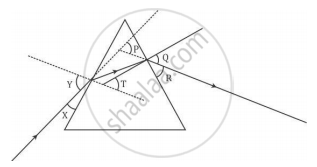
In this diagram the angle of incidence, the angle of emergence and the angle of deviation respectively are (select the correct option):
(A) X, R and T
(B) Y, Q and T
(C) X, Q and P
(D) Y, Q and P
As light rays pass from air into a glass prism, are they refracted towards or away from the normal?
Which is refracted most by a prism : red light or violet light? Explain why?
A beam of white light falls on a glass prism. The colour of light which undergoes the least bending on passing through the glass prism is:
(a) violet
(b) red
(c) green
(d) blue
Which of the following colour of white light has the least wavelength?
(a) red
(b) orange
(c) violet
(d) blue
Out of the following, the colour of light having the maximum wavelength is:
(a) violet
(b) indigo
(c) green
(d) orange
Write three conditions necessary to obtain a pure spectrum on a screen. Name the instrument in which the conditions stated by you are fulfilled.
In the following diagram showing dispersion of white light by a glass prism, the colours 'P' and 'Q’ respectively are:

When sunlight passes through water droplets in the atmosphere it gets dispersed into its constituent colours forming a rainbow. A similar phenomenon is observed when white light passes through a prism.
Which colour will show the maximum angle of deviation and which colour will show the minimum angle of deviation?
