Advertisements
Advertisements
प्रश्न
Study the following figure in which a student has marked the angle of incidence (∠i), angle of refraction (∠r), angle of emergence (∠e), angle of prism (∠A) and the angle of deviation (∠D). The correctly marked angles are
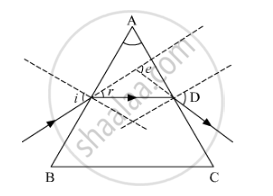
(a) ∠A and ∠i
(b) ∠A, ∠i and ∠r
(c) ∠A, ∠i, ∠e and ∠D
(d) ∠A, ∠i, ∠r and ∠D
Advertisements
उत्तर
The correctly marked angles in the given figure are the angle of prism (A) and the angle of incidence (i).
All the angles are correctly marked in the figure shown below.
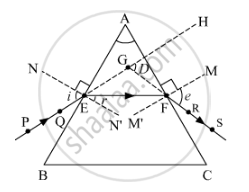
Hence, the correct answer is option (a).
APPEARS IN
संबंधित प्रश्न
In the formation of spectrum of white light by a prism:
which colour is deviated most?
What will happen if another similar glass prism is placed upside down behind the first prism?
The coloured light having the maximum speed in glass prism is ______.
Draw a labeled ray diagram to illustrate the dispersion of a narrow beam of white light when it passes through a glass prism.
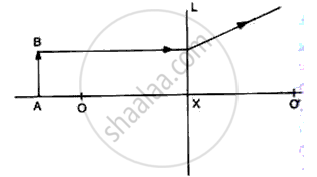
Refer to fig
(i) Name the lens L.
(ii) What are the points O, O' called?
(iii) Complete the diagram to form the image of the object AB.
(iv) Write three characteristics of the image.
Write three conditions necessary to obtain a pure spectrum on a screen. Name the instrument in which the conditions stated by you are fulfilled.
The sunlight can be split into its constituent colors using ______.
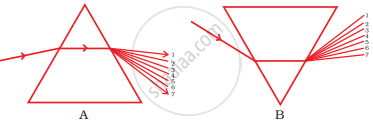
State the correct sequence (1-7) of colours in the spectrum formed by the prisms A and B, shown in the following figure.
Assertion: We can see the rainbow in the sky when the rain starts falling after a spell of bright sunlight.
Reason: The rainbow is formed due to the dispersion of light.
______ colour is deviated the least in the spectrum of white light obtained with a glass prism.
