Advertisements
Advertisements
Question
Study the following figure in which a student has marked the angle of incidence (∠i), angle of refraction (∠r), angle of emergence (∠e), angle of prism (∠A) and the angle of deviation (∠D). The correctly marked angles are
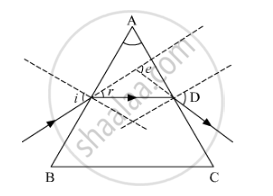
(a) ∠A and ∠i
(b) ∠A, ∠i and ∠r
(c) ∠A, ∠i, ∠e and ∠D
(d) ∠A, ∠i, ∠r and ∠D
Advertisements
Solution
The correctly marked angles in the given figure are the angle of prism (A) and the angle of incidence (i).
All the angles are correctly marked in the figure shown below.
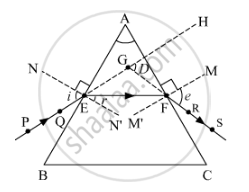
Hence, the correct answer is option (a).
APPEARS IN
RELATED QUESTIONS
In the following ray diagram the correctly marked angle are:

(a) ∠i and ∠e
(b) ∠A and ∠D
(c) ∠i, ∠e and ∠D
(d) ∠r, ∠A and ∠D
What happens when a ray of ordinary light is passed through a triangular glass prism?
Out of the following, the colour of light having the maximum wavelength is:
(a) violet
(b) indigo
(c) green
(d) orange
In the spectrum of white light by a prism, the colour at the extreme end opposite to the base of prism is ______.
Write the range of wavelength of the visible spectrum.
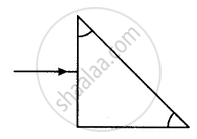
In the diagram, a narrow beam of white light is incident on a right-angled isosceles prism. The critical angle of the material of prism for the yellow colour of white light is 45°. Complete the diagram to show the path of blue, yellow, and red colours of white light till they emerge out of the prism.
Which of the following is a natural phenomenon which is caused by the dispersion of sunlight in the sky?
What is Newton’s disc?
The dispersive powers of flint glass and crown glass are 0.053 and 0.034, respectively and their mean refractive indices are 1.68 and 1.53 for white light. Calculate the angle of the flint glass prism required to form an achromatic combination with a crown glass prism of refracting angle 4°:
