Advertisements
Advertisements
प्रश्न
Differentiate between a glass slab and a glass prism.
Advertisements
उत्तर
Glass slab: It is rectangular in shape and made up of glass. In glass slab, the direction of the incident ray and the emergent ray of light are parallel to each other.
Glass Prism: It has two triangular sides, two inclined rectangular sides, and one rectangular base. In glass prism, the direction of the incident ray and the emergent ray of light is not parallel to each other.
APPEARS IN
संबंधित प्रश्न
Why do the component colours of incident white light split into a spectrum while passing through a glass prism, explain
Draw a diagram to show the refraction of light through a glass prism. On this diagram, mark
(i) incident ray
(ii) emergent ray, and
(iii) angle of deviation.
The colour of white light which is deviated the maximum on passing through the glass prism is:
(a) blue
(b) indigo
(c) red
(d) orange
A ray of white light falls on a prism. Draw a ray diagram to show that the prism disperses the white light.
What do you understand by the term spectrum?
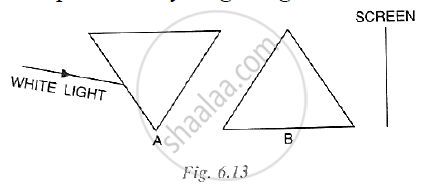
Complete the ray diagram given below to show the nature of light produced on the screen.
In an experiment to trace the path of a ray of light through a glass prism for different values of angle of incidence a student would find that the emergent ray:
(A) is parallel to the incident ray
(B) perpendicular to the incident ray
(C) is parallel to the refracted ray
(D) bends at an angle to the direction of incident ray
Draw a labeled ray diagram to illustrate the dispersion of a narrow beam of white light when it passes through a glass prism.
Write the range of wavelength of the ultraviolet spectrum.
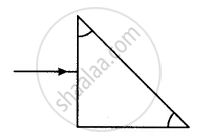
In the diagram, a narrow beam of white light is incident on a right-angled isosceles prism. The critical angle of the material of prism for the yellow colour of white light is 45°. Complete the diagram to show the path of blue, yellow, and red colours of white light till they emerge out of the prism.