Advertisements
Advertisements
Question
We can see the sun even when it is little below the horizon because of ______.
Options
Reflection of light
Refraction of light
Dispersion of light
Absorption of light
Advertisements
Solution
We can see the Sun even when it is little below the horizon because of refraction of light.
Explanation:
We can see the Sun even when it is a little below the horizon because of atmospheric refraction. The Earth’s atmosphere bends the light from the Sun upwards towards the eye of the observer. Even though the Sun itself might be just below the horizon line, the light is refracted or bent by the atmosphere, thus making the Sun appear to be visible.
RELATED QUESTIONS
The letter F is placed in front of a plane mirror:
- How would its image look like when seen in a plane mirror?
- What is the name of the phenomenon involved?
What are the important differences between looking at a photograph of your face and looking at yourself in a plane mirror?
Write all the capital letters of the alphabet which look the same in a plane mirror.
The figure given alongside shows the image of a clock as seen in a plane mirror. The correct time is:
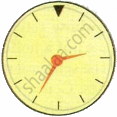
A man sits in an optician's chair looking into plane mirror which is 2 m away from him and views the image of a chart which faces the mirror and is 50 cm behind his head. How far away from his eyes does the chart appear to be?
If a ray of light goes form a denser medium to a rarer medium, will it bend towards the normal or away from the normal?
A ray of light travelling in glass emerges into air. State whether it will bend towards the normal or away from the normal.
State two effects caused by the refraction of light.
A ray of light passes from air into a block of glass. Does it bend towards the normal or away from it?
Fill in the following blank with suitable word:
Light travelling along a normal is ...............refracted.
Fill in the following blank with suitable word:
Light bends when is passes from water into air. We say that it is ............
What is meant by ‘refraction of light’?
A ray of light travelling in air is incident on a rectangular glass block and emerges out into the air from the opposite face. Draw a labelled ray diagram to show the completer path of this ray of light. Mark the two points where the refraction of light takes place. What can you say about the final direction of ray of light?
A coin in a glass tumbler appears to rise as the glass tumbler is slowly filled with water. Name the phenomenon responsible for this effect.
State two factors on which the lateral displacement of the emergent ray depends.
Light travelling from a denser medium to a rarer medium along a normal to the boundary:
(a) is refracted towards the normal
(b) is refracted away from the normal
(c) goes along the boundary
(d) is not refracted
A vertical ray of light strikes the horizontal surface of some water:
What is the angle of refraction?
Water is optically denser than glass.
The depth of a pond when seen from above appears to be less.
Identify the wrong figure from the following.
Write scientific reason.
The sun appears on the western horizon for some time after sunset.
Write scientific reason.
A pencil appears to be broken near the surface of water.
The refractive index of four substances A, B, C, and D are 1.31, 1.43, 1.33, 2.4 respectively. The speed of light is maximum in
You are given water, mustard oil, glycerine and kerosene. In which of these media a ray of light incident obliquely at same angle would bend the most?
The ratio of the sine of the angle of incidence to the sine of ______ is constant.
Light is refracted or bent while going from one medium to another because of its ______ changes.
How do twinkling stars occur? (or) what is the cause of the twinkling of stars?
In refraction of light through a glass slab, the directions of the incident ray and the refracted ray are ______.
The part of light that enters into the other medium and travels in a straight path but in a direction different from its initial direction is called:
A normal is an imaginary line drawn ________ to the boundary at the point of incidence.
When a light ray passes from a denser medium to a rarer medium, it bends:
The constant \[\frac{\sin i}{\sin r}\] for a given pair of media is called the:
Which of the following relations is called Snell's Law?
In the formula for absolute refractive index \[n = \frac{c}{v}\], the quantity c represents:
A larger refractive index of a medium means that light travels:
To a crane, a fish appears 6 cm below the water surface. Taking the refractive index of water as \[\frac{4}{3}\], the real depth of the fish below the surface is:
