Advertisements
Advertisements
Question
Explain why, though both a plane mirror and a sheet of paper reflect light but we can see the image of our face in a plane mirror but not in a sheet of paper.
Advertisements
Solution
This is because there occurs regular reflection from a plane mirror, which has a smooth surface. Since the particles of the smooth surface are facing one direction, a beam of parallel light rays falling on it is reflected as a beam of parallel light rays in one direction only. These rays meet when produced backwards to form a virtual image of the light source.
However, in the case of a rough paper, a parallel beam of incident light is reflected in different directions (diffused reflection). So, the light rays don't meet to form an image of the object.
APPEARS IN
RELATED QUESTIONS
The letter F is placed in front of a plane mirror:
- How would its image look like when seen in a plane mirror?
- What is the name of the phenomenon involved?
What are the important differences between looking at a photograph of your face and looking at yourself in a plane mirror?
A boy with a mouth 5 cm wide stands 2 m away from a plane mirror. Where is his image and how wide is the image of his mouth?
State and explain the laws of reflection of light at a plane surface (like a plane mirror), With the help of a labelled ray-diagram. Mark the angles of 'incidence' and 'reflection' clearly on the diagram. If the angle of reflection is 47.5°, what will be the angle of incidence?
The image formed by a plane mirror is :
(a) virtual, behind the mirror and enlarged.
(b) virtual, behind the mirror and of the same size as the object.
(c) real, at the surface of the mirror and enlarged.
(d) real, behind the mirror and of the same size as the object.
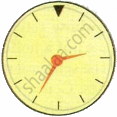
The figure given alongside shows the image of a clock as seen in a plane mirror. The correct time is:
A ray of light strikes a plane mirror PQ at an angle of incidence of 30°, is reflected from the plane mirror and then strikes a second plane mirror QR placed at right angles to the first mirror. The angle of reflection at the second mirror is ______.
As light rays pass from water into glass, are they refracted towards the normal or away from the normal?
Light travelling from a denser medium to a rarer medium along a normal to the boundary:
(a) is refracted towards the normal
(b) is refracted away from the normal
(c) goes along the boundary
(d) is not refracted
A ray of light passes from a medium X to another medium Y. No refraction of light occurs if the ray of light hits the boundary of medium Y at an angle of:
(a) 0°
(b) 45°
(c) 90°
(d) 120°
Air is optically .......... than glass.
Choose and write the correct option.
If we gradually increase the angle of incidence of a ray of light passing through prism then …..
Light enters from air to glass having refractive index 1.50. What is the speed of light in the glass? The speed of light in vacuum is 3 × 10⁸ m s−1.
Lights of different colours are used as signal for safety transport. From these, the wavelength of red light is _______ nm.
Write scientific reason.
The sun appears on the western horizon for some time after sunset.
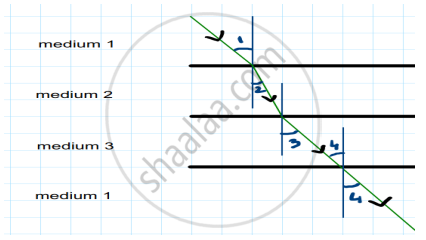
In the above diagram light is travelling through different media. It is noted by a scientist that ∠1= ∠3 = ∠4 but ∠2 < ∠1. Which of the following statement would be correct?
Which object use the reflection of light?
The phenomenon of light passing through the object is called ______.
When light passes from one medium to another the ray gets bent. This property of light is called ______.
The constant \[\frac{\sin i}{\sin r}\] for a given pair of media is called the:
