Advertisements
Advertisements
Question
What is lateral inversion? Explain by giving a suitable example.
Advertisements
Solution
When an object is placed in front of a plane mirror, the right side of the object appears as the left side in its image; and the left side of the object appears as the right side in the image. This change of sides of an object and its mirror image is called lateral inversion. For example, the right hand of a person appears as the left hand in the image formed by a plane mirror.
APPEARS IN
RELATED QUESTIONS
State whether the following statement is true of false:
A student says that we can see an object because light from our eyes is reflected back by the object.
Define the following terms used in the study of reflection of light by drawing a labelled ray-diagram:
- Incident ray
- Point of incidence
- Normal
- Reflected ray
- Angle of incidence
- Angle of reflection
The image of an object formed by a plane mirror is:
(a) virtual
(b) real
(c) diminished
(d) upside-down
The figure given alongside shows the image of a clock as seen in a plane mirror. The correct time is:
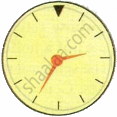
An object is placed 20 cm in front of a plane mirror. The mirror is moved 2 cm towards the object. The distance between the positions of the positions of the original and final images seen in the mirror is ______.
If a ray of light goes from a rarer medium to a denser medium, will it bend towards the normal or away from it?
As light rays pass from water into glass, are they refracted towards the normal or away from the normal?
Why does a ray of light bend when it travels from one medium to another?
With the help of a labelled diagram, explain why a tank full of water appears less deep than it actually is.
When a ray of light travelling in glass enters into water obliquely ______.
Match the Following
| Column A | Column B |
| (a) white Light | (1) Convex mirror |
| (b) Refraction | (2) Concave mirror |
| (c) Virtual images | (3) refraction |
| (d) Real images | (4) spectrum |
| (e) Prism | (5) ray of light from glass to air |
What do you understand by refraction of light?
Draw suitable diagrams to illustrate how a beam of light incident parallel to the principal axis is reflected by:
(a) a concave mirror, and (b) a convex mirror
A small air bubble in a glass block when seen from above appears to be raised because of ______.
Choose and write the correct option.
If we gradually increase the angle of incidence of a ray of light passing through prism then …..
Identify the wrong figure from the following.
The bending of light as it passes from one medium to another is called ______.
The ratio of the sine of the angle of incidence to the sine of ______ is constant.
In refraction of light through a glass slab, the directions of the incident ray and the refracted ray are ______.
