Advertisements
Advertisements
प्रश्न
What is lateral inversion? Explain by giving a suitable example.
Advertisements
उत्तर
When an object is placed in front of a plane mirror, the right side of the object appears as the left side in its image; and the left side of the object appears as the right side in the image. This change of sides of an object and its mirror image is called lateral inversion. For example, the right hand of a person appears as the left hand in the image formed by a plane mirror.
APPEARS IN
संबंधित प्रश्न
| Column I | Column II | Column III | |
| 1 | Dispersion | Long-sightedness | Twinkling of stars |
| 2 | Refraction | Splitting of white light into component colours | Convex lens |
| 3 | Hypermetropia | Change in the direction of the ray of light due to change in medium | Spectrum of seven colours |
What is the difference between regular reflection of light and diffuse reflection of light?
The figure given alongside shows the image of a clock as seen in a plane mirror. The correct time is:
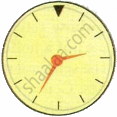
An object is placed 20 cm in front of a plane mirror. The mirror is moved 2 cm towards the object. The distance between the positions of the positions of the original and final images seen in the mirror is ______.
If a ray of light goes from a rarer medium to a denser medium, will it bend towards the normal or away from it?
Which phenomenon of light makes the water to appear shallower than it really is?
A ray of light travelling in air is incident on a rectangular glass block and emerges out into the air from the opposite face. Draw a labelled ray diagram to show the completer path of this ray of light. Mark the two points where the refraction of light takes place. What can you say about the final direction of ray of light?
How does the light have to enter the glass:
to produce a large amount of bending?
Image is formed by a mirror due to refraction of light.
Draw suitable diagrams to illustrate how a beam of light incident parallel to the principal axis is reflected by:
(a) a concave mirror, and (b) a convex mirror
The refractive index of a transparent medium is always greater than ______.

The angle of incidence from air to glass at the point O on the hemispherical glass slab is.
The bending of light as it passes from one medium to another is called ______.
Which is optically denser out of the two medium M1& M2 having the refractive indices = 1.71 and 1.36 respectively?
When a light ray passes from a denser medium to a rarer medium, it bends:
When light travels from a denser medium to a rarer medium, its speed:
According to the first law of refraction, the incident ray, the refracted ray, and the normal at the point of incidence:
Which of the following relations is called Snell's Law?
The absolute refractive index of a medium is given by:
In the formula for absolute refractive index \[n = \frac{c}{v}\], the quantity c represents:
