Advertisements
Advertisements
Questions
Explain how the formation of a rainbow occurs.
Explain the phenomenon of rainbow formation in the sky. Draw the labelled ray diagram in support of your explanation.
Advertisements
Solution
- The beautiful phenomenon of the rainbow is a combination of different phenomena, such as dispersion, refraction, and reflection of light.
- The rainbow appears in the sky after a rain shower.
- The water droplets act as small prisms.
- When sunlight enters the water droplets present in the atmosphere, they refract and disperse the incident sunlight.
- Then they reflect it internally within the droplet and finally refract it again.
- As a collective effect of all these phenomena, the seven coloured rainbows are observed.

RELATED QUESTIONS
Name the phenomenon responsible for the following effect:
When we sit in front of a plane mirror and write with our right hand, it appears in the mirror that we are writing with the left hand.
What are the important differences between looking at a photograph of your face and looking at yourself in a plane mirror?
A wall reflects light and a mirror also reflects light. What difference is three in the way they reflect light?
What type of reflection of light takes place from a cinema screen?
A boy with a mouth 5 cm wide stands 2 m away from a plane mirror. Where is his image and how wide is the image of his mouth?
The boy walks towards the mirror at a speed of 1 m/s. At what speed does his image approach him?
What is meant by 'reflection of light'?
An object is placed 20 cm in front of a plane mirror. The mirror is moved 2 cm towards the object. The distance between the positions of the positions of the original and final images seen in the mirror is ______.
A man sits in an optician's chair looking into plane mirror which is 2 m away from him and views the image of a chart which faces the mirror and is 50 cm behind his head. How far away from his eyes does the chart appear to be?
When a ray of light passes from air into glass, is the angle of refraction greater than or less than the angle of incidence?
A ray of light passes from air into a block of glass. Does it bend towards the normal or away from it?
State whether the following statement is true or false:
Refraction occurs because light slows down in denser materials.
A ray of light passes from a medium X to another medium Y. No refraction of light occurs if the ray of light hits the boundary of medium Y at an angle of:
(a) 0°
(b) 45°
(c) 90°
(d) 120°
How does the light have to enter the glass:
to produce a large amount of bending?
Water is optically denser than glass.
The speed of light is more in glass than in water.
Light travels at a lower speed in water than in air.
Image is formed by a mirror due to refraction of light.
When a ray of light travels from air to glass, it bends .......... the normal.
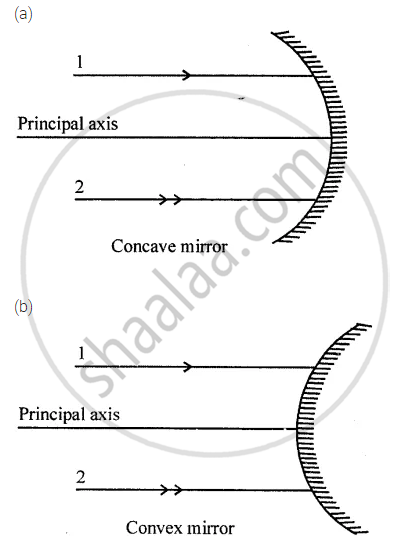
Draw suitable diagrams to illustrate how a beam of light incident parallel to the principal axis is reflected by:
(a) a concave mirror, and (b) a convex mirror
The diagram (figure) given below shows two parallel rays 1 and 2 incident on (a) a concave mirror, (b) a convex mirror. Draw the reflected rays and mark the focus by the symbol F.
What is the cause of refraction of light when it passes from one medium to another?
We can see the sun even when it is little below the horizon because of ______.
List four characteristics of the image formed by a concave lens of focal length 20 cm when the object is placed at a distance of 40 cm from its optical centre.
The size of image of an object by a convex lens of focal length 20 cm is observed to be reduced to `1/3` rd of its size . Find the distance of the object from the optical centre of the lens .
The phenomenon of change in the direction of light when it passes from one transparent medium to another is called ___________.
Due to _______ pencil looks bent in water, in the given experiment.
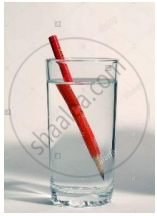
Light changes its direction when going from one transparent medium to another transparent medium. This is called _______.
Explain with diagrams how refraction of incident light takes place from
- rarer to denser medium
- denser to rarer medium
- normal to the surface separating the two media.
What is refractive index?
You are given water, mustard oil, glycerine and kerosene. In which of these media a ray of light incident obliquely at same angle would bend the most?
The deviation of light ray from its path when it travels from one transparent medium to another transparent medium is called ______.
Which surface will not reflect most of the light falling on them?
A water tank appears shallower when it is viewed from the top due to refraction.
Why a pencil partly immersed in water appears to be bent at the water surface.
