English Medium
Academic Year: 2025-2026
Date & Time: 25th February 2026, 10:30 am
Duration: 3h
Advertisements
General Instructions:
Read the following instructions carefully and follow them:
- This question paper contains 39 questions. All questions are compulsory.
- The question paper is divided into three sections - A, B and C.
Section A: Biology (30 Marks)
Section B: Chemistry (25 Marks)
Section C: Physics (25 Marks) - The question paper has MCQs, VSAs, SAs, LAs and CBQs. Marks are given against each question.
- There are case based questions (CBQs) with three sub-questions and are of 4 marks each.
- Divide your answer sheet into three sections as per the question paper -
Section A (Biology), Section B (Chemistry) and Section C (Physics).
It is compulsory to answer each question in its respective section. Do not mix answers of one section into the other section. - Instructions are given with each section and question, wherever necessary.
- Kindly note that a separate question paper has been provided for visually impaired candidates.
- There is no overall choice in the question paper. However, an internal choice has been provided in a few questions. Only one of the choices in such questions must be attempted.
Observe the given figure and select the statement that correctly states how these fungi obtain nutrition.
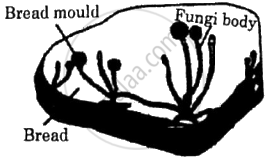
By eating the bread on which it is growing.
By using nutrients from the bread to prepare their own food.
By breaking down the nutrients of bread outside the body and then absorbing them.
By allowing other organisms to grow on the bread and then consuming them.
Chapter:
If the part ‘P’ of the flower is removed, which of the following processes will not take place?
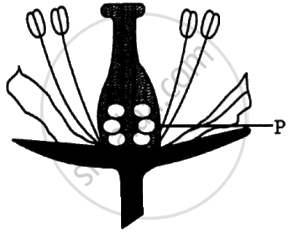
Formation of pollens
Formation of flower
Formation of fruit
Formation of seed
Chapter:
Given below are some of the statements regarding our environment:
- Change in our life-styles have resulted in greater amounts of waste material generation.
- Changes in attitude have resulted in use of more disposable things.
- Changes in packaging has resulted in much of our waste becoming non-biodegradable.
- Organic farming.
Which amongst these is not leading to any damage of environment?
(i), (ii), (iii)
(iv)
(i) and (iii)
(ii) and (iv)
Chapter:
Identify the traits that cannot be transmitted from parents to the offsprings:
- Swimming technique
- Blood group
- Eye colour
- Dancing skills
(i) and (ii)
(i) and (iv)
(iii) and (iv)
(ii) and (iii)
Chapter:
Following are the statements about the different parts of the brain. Select the correct statements.
- The thinking part of the brain is the forebrain.
- Centres for smell, hearing, memory, sight are located in forebrain.
- Salivation, vomiting, blood pressure are controlled by medulla in the hind brain.
- Cerebellum does not control the posture and balance of the body.
(i), (ii) and (iii)
(ii), (iii) and (iv)
(i), (ii) and (iv)
(i), (iii) and (iv)
Chapter:
Two pen plants, one with round green seeds (RRyy) and another with wrinkled yellow (rrYY) seeds were crossed with each other which produced F1 progeny that have only round yellow (RrYy) seeds. When F1 plants are self-pollinated, the F2 progeny will have which new combination of characters, as compared to the parents:
- Round, yellow
- Round, green
- Wrinkled, yellow
- Wrinkled, green
(i) and (ii)
(i) and (iv)
(ii) and (iv)
(i) and (iii)
Chapter:
In human beings the oxygen rich blood is pumped out to the body by ______.
contraction of right atrium.
relaxation of left ventricle.
contraction of right ventricle.
contraction of left ventricle.
Chapter:
Assertion (A): Variations are not often seen in off-springs produced by asexual reproduction.
Reason (R): DNA molecule generated by replication is not similar to the original DNA.
Both Assertion (A) and Reason (R) are true and Reason (R) is the correct explanation of the Assertion (A).
Both Assertion (A) and Reason (R) are true, but Reason (R) is not the correct explanation of the Assertion (A).
Assertion (A) is true, but Reason (R) is false.
Assertion (A) is false, but Reason (R) is true.
Chapter:
Assertion (A): Highest percentage of pesticides is found in tertiary consumers in a food chain.
Reason (R): Chemicals/pesticides get accumulated progressively at each trophic level.
Both Assertion (A) and Reason (R) are true and Reason (R) is the correct explanation of the Assertion (A).
Both Assertion (A) and Reason (R) are true, but Reason (R) is not the correct explanation of the Assertion (A).
Assertion (A) is true, but Reason (R) is false.
Assertion (A) is false, but Reason (R) is true.
Chapter:
“Transpiration in plants is a necessary evil.” Comment on the statement giving two reasons.
Chapter:
Explain why, a food chain usually cannot have more than three or four steps.
Chapter:
Varun is diabetic. His latest ultrasound reports showed a blockage in his pancreatic duct. How will this affect the dual functioning of the pancreas?
Chapter:
Sunil unconsciously touched the hot iron rod and immediately withdrew his hand. Which type of action is involved? Also define this action. Draw a flow chart to show the path followed for this action.
Chapter:
Give reasons for the following:
Adrenal gland is known as the stress gland of the body.
Chapter:
Give reasons for the following:
Prenatal sex determination is banned in India.
Chapter:
Give reasons for the following:
Vegetative propagation is advantageous in some plants.
Chapter:
Study the given table and answer the following questions:
| Parents | F1 | F2 |
| A pea plant with red flowers was crossed with a pea plant with white flowers. | 30 seeds were sown and all bore plants with red flowers. | 44 seeds were sown, 33 plants bore red flowers and 11 plants bore white flowers. |
- Depict the information given in the table in the form of a cross.
- Deduce the F2 phenotypic ratio/F2 ratio showing external look aв well as genotypic/genetic makeup, ratio.
Chapter:
| Plants exhibit movements in response to various environmental stimuli to adopt and survive in their surroundings. These movements, influenced by external factors such as light, gravity, water and chemicals are regulated by specific plant hormones. For example, the differential growth of plant parts allows them to bend, grow or orient themselves in particular directions. Roots and shoots often show contrasting response to the same stimulus, highlighting the complex mechanisms involved in plant growth and development. |
(a) Why is hydrotropism essential for plants?
(b) What role does auxin play in the growth of plants?
(c) Differentiate between movement shown by the sensitive plant and tropic movement by plants (Two points).
OR
(c) How does movement of roots differ from that of shoots in response to gravity and light?
Chapter:
Draw a labelled diagram showing open stomatal pore.
Chapter:
Draw a labelled diagram showing closed stomatal pore.
Chapter:
Mention the major events during photosynthesis.
Chapter:
Write the overall chemical equation for photosynthesis.
Chapter:
Advertisements
Write the role of capillary cluster inside Bowman’s capsule.
Chapter:
The volume ratio of hydrogen and oxygen gases liberated during electrolysis of water is ______.
1 : 1
2 : 1
4 : 1
1 : 2
Chapter:
\[\ce{C6H12O6_{(aq)} + 6O2_{(g)} -> 6CO2_{(g)} + 6H2O_{(l)}}\]
The above reaction is an example of ______.
Displacement Reaction
Endothermic Reaction
Exothermic Reaction
Neutralisation Reaction
Chapter:
An aqueous solution turns red litmus blue. Excess addition of which of the following solution would reverse the change?
Sodium hydroxide
Hydrochloric acid
Baking soda
Slaked lime
Chapter:
While washing dirty clothes by soap, micelles are formed. Select the correct statement about micelles.
The hydrophobic tail of the soap molecule is in the interior of the cluster, whereas hydrophilic end is on the surface of the cluster.
The hydrophobic tail is on the surface of the cluster, whereas hydrophilic end is in the interior of cluster.
Both hydrophobic tail and hydrophilic end are in the interior of the cluster.
Both hydrophobic tail and hydrophilic end are on the surface of the cluster.
Chapter:
Which one of the following metals does not react with cold water?
Sodium
Potassium
Calcium
Magnesium
Chapter:
Alloys are homogeneous mixtures of a metal with a metal or non-metal. Which among the following alloys contain non-metal as one of its constituents?
Brass
Bronze
Amalgam
Steel
Chapter:
How will you protect yourself from the heat generated while diluting a concentrated acid?
By adding acid to water with constant stirring.
By adding water to acid with constant stirring.
By adding water to acid followed by base.
By adding base to acid with constant stirring.
Chapter:
Assertion (A): Pure ethanoic acid is also known as glacial acetic acid.
Reason (R): Pure ethanoic acid often freezes during winter due to its low melting point of 290 K.
Both Assertion (A) and Reason (R) are true and Reason (R) is the correct explanation of the Assertion (A).
Both Assertion (A) and Reason (R) are true, but Renson (R) is not the correct explanation of the Assertion (A).
Assertion (A) is true, but Reason (R) is false.
Assertion (A) is false, but Reason (R) is true.
Chapter:
A compound ‘A’ is used in soda-lime fire-extinguisher and decomposes on heating to form compound ‘B’. Compound ‘B’ is used for removing permanent hardness of water. Identify ‘A' and ‘B’.
Chapter:
Write the chemical formula of Plaster of Paris.
Chapter:
At what temperature gypsum is heated to obtain Plaster of Paris?
Chapter:
Account for the following:
White silver chloride turns grey when exposed to sunlight.
Chapter:
Account for the following:
Lead (II) nitrate on heating releases brown fumes.
Chapter:
Account for the following:
Bags of oil and fat containing food items are flushed with nitrogen gas.
Chapter:
Which method will be used to convert it to its respective metal oxide?
Carbonate ore
Chapter:
Which method will be used to convert it to its respective metal oxide?
Sulphide ore
Chapter:
Write a chemical equation to illustrate the use of aluminium for joining cracked railway lines.
Chapter:
Name the anode and the cathode used in the electrolytic refining of impure copper metal.
Chapter:
Write all the reactions involved in the extraction of Zn from ZnS.
Chapter:
Hydrogen gas is not evolved when most of the metals react with nitric acid. Give reason.
Chapter:
| The pH plays an important role in our daily life. Strength of acids and bases depends on the number of H+ ions and OH− ions produced by these respectively. pH scale helps in predicting the strength of acids and bases by measuring hydrogen ion concentration in a solution. |
Answer the following:
(a) What type of indicator is used to predict how strong an acid or base is? [1]
(b) Three solutions A, B and C showed pH as 3, 5 and 7. Which solution has the highest concentration of H+ ions? [1]
(c) What are strong acids and weak acids?
OR
(c) (i) Under what condition is rainwater called acid rain? [2]
(ii) In the following acids, identify weak acids:
Nitric acid, hydrochloric acid, acetic acid, sulphuric acid, formic acid. [2]
Chapter:
Advertisements
Carbon cannot form C4+ cation and C4− anion. Explain.
Chapter:
Define a homologous series of carbon compounds.
Chapter:
Why are the melting and boiling points of C4H10 higher than C3H8 or C2H6?
Chapter:
What happens when ethanol is heated with acidified potassium dichromate?
Chapter:
How would you name the following:
\[\begin{array}{cc}
\ce{CH3 - CH2 - C = O}\\
\phantom{...............}|\\
\phantom{...............}\ce{H}\\
\end{array}\]
Chapter:
How would you name the following:
\[\ce{CH3 - C ≡ CH}\]
Chapter:
When ethanol reacts with ethanoic acid in the presence of conc. H2SO4, a substance with sweet smell is produced. Answer the following:
- State the class of compounds to which the sweet smelling compounds belong.
- Write the chemical equation for the reaction.
Chapter:
The pair of eye parts responsible for admitting different amount of light in to the eyes is ______.
Iris and pupil
Ciliary muscles and pupil
Retina and Iris
Ciliary muscles and cornea
Chapter:
The vision defect which arises due to gradual weakning of the ciliary muscles and diminishing flexibility of eye lens is ______.
Myopia
Hypermetropia
Presbyopia
Myopia and hyprmetropia both
Chapter:
Assertion: With the help of compass, magnetic field lines can be traced outside the bar magnet.
Reason: The north pole of a compass needle always points towards the south pole of the magnet when bought close to it.
Both Assertion (A) and Reason (R) are true and Reason (R) is the correct explanation of the Assertion (A).
Both Assertion (A) and Reason (R) are true, but Reason (R) is not the correct explanation of the Assertion (A).
Assertion (A) is true, but Reason (R) is false.
Assertion (A) is false, but Reason (R) is true.
Chapter:
A fuse in electric circuit is rated 4 A. Can it be used with an electric heater of rating 2 kW, 200 V? Explain your answer.
Chapter:
State two ways through which the strength of an electromagnet can be increased.
Chapter:
Calculate the work done required to move an electron between two points A and B located at a potential difference of 100 V in an electric field.
Chapter:
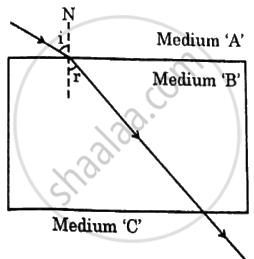
Observe the given ray diagram and compare:
- the speed of light in medium A and the speed of light in medium B.
- the optical densities of medium B and medium C.
Chapter:
Draw a ray diagram for refraction where the optical density of medium ‘A’ becomes equal to the optical density of medium ‘C’ and optical density of medium ‘B’ is greater than the optical density of medium ‘A’ and medium ‘C’.
Chapter:
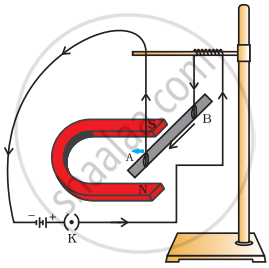
On the basis of the given circuit arrangement, answer the following questions:
- What happens to the rod AB when the key K is closed and why?
- Name and state the rule that determines this behaviour of the rod AB in the above situation.
Chapter:
|
The above ray diagram is to show image formation by a reflecting telescope. Reflecting telescope revolutionized our way of looking into the sky. Reflecting telescopes employ large mirrors to gather and focus light rather than relying solely on lenses as we do in the refracting telescopes. These telescopes utilize precisely shaped and polished mirrors to capture incoming light and reflect it to a focal point, where the telescope forms an image for observation. |
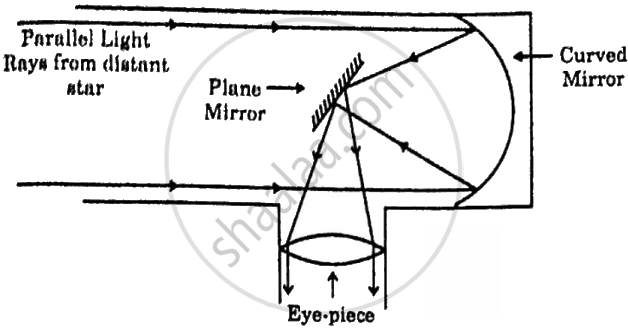
(a) What kind of image of a star is seen by the observer in the eye-piece
(b) What kind of mirror is used in this reflecting telescope?
(c) Explain with the reason, what kind of optical device (type of lens or mirror) is used at the eye-piece.
OR
(c) What is the role of plane mirror in mage formation by this telescope?
Chapter:
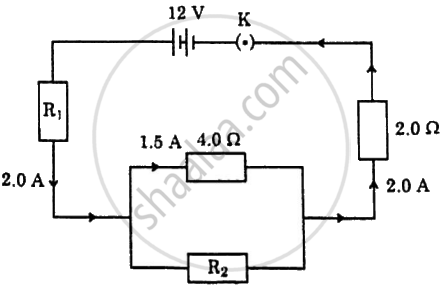
- The given electric circuit is a part of an electrical device. Use the information given in the electric circuit diagram to calculate:
- Potential difference across the ends of resistor R2.
- Value of resistor R1.
-
Write the factors on which resistance of a conductor depends and derive the formula for resistance of a given conductor.
Chapter:
How much electric current will an electric iron draw from 220 V source if the resistance of its heating element when hot, is 55 Ω? Calculate the power consumed by the electric iron when it is operated at 220 V.
Chapter:
In a house, 3 bulbs of 100 watt each, are lit for 5 hours daily and an electric heater of 1.0 kW is used for half an hour daily. Calculate the total energy consumed in a month of 30 days and its cost at the rate of ₹ 3.60 per kWh.
Chapter:
Why are alloys commonly used in electrical heating devices? Give reason.
Chapter:
Other Solutions
Submit Question Paper
Help us maintain new question papers on Shaalaa.com, so we can continue to help studentsonly jpg, png and pdf files
CBSE previous year question papers Class 10 Science with solutions 2025 - 2026
Previous year Question paper for CBSE Class 10 Science-2026 is solved by experts. Solved question papers gives you the chance to check yourself after your mock test.
By referring the question paper Solutions for Science, you can scale your preparation level and work on your weak areas. It will also help the candidates in developing the time-management skills. Practice makes perfect, and there is no better way to practice than to attempt previous year question paper solutions of CBSE Class 10.
How CBSE Class 10 Question Paper solutions Help Students ?
• Question paper solutions for Science will helps students to prepare for exam.
• Question paper with answer will boost students confidence in exam time and also give you an idea About the important questions and topics to be prepared for the board exam.
• For finding solution of question papers no need to refer so multiple sources like textbook or guides.
