Advertisements
Advertisements
Question
A ray of light passes from air into a block of glass. Does it bend towards the normal or away from it?
Advertisements
Solution
We know that air is a rarer medium and glass is a denser medium. When a ray of light goes from a rarer medium to a denser medium, it bends towards the normal. So, the light ray will bend towards the normal in the given case.
APPEARS IN
RELATED QUESTIONS
State whether the following statement is true of false:
A student says that we can see an object because light from our eyes is reflected back by the object.
With the help of a labelled ray-diagram, describe how a plane mirror forms an image of a point source of light placed in front of it. State the characteristics of the image formed in a plane mirror.
The image in a plane mirror is virtual and laterally inverted. What does this statement mean?
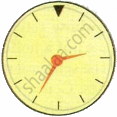
The figure given alongside shows the image of a clock as seen in a plane mirror. The correct time is:
Explain how to read the following message which was found on some blotting paper:

If a ray of light goes from a rarer medium to a denser medium, will it bend towards the normal or away from it?
Which phenomenon of light makes the water to appear shallower than it really is?
Name the phenomenon due to which a pencil partly immersed in water and held obliquely appears to be bent at the water surface.
The depth of a pond when seen from above appears to be less.
Image is formed by a mirror due to refraction of light.
The laws of reflection hold true for ______.
Write scientific reason.
The sun appears on the western horizon for some time after sunset.
Why does a ray of light bend when it travels from one medium to another?
Numerical problems.
The speed of light in water is 2.25 × 10⁸ ms–1. If the speed of light in vacuum is 3 × 10⁸ ms–1, calculate the refractive index of water.
Under what circumstances there won’t be any refraction of light when it enters from one medium to another?
The part of light that enters into the other medium and travels in a straight path but in a direction different from its initial direction is called:
The constant \[\frac{\sin i}{\sin r}\] for a given pair of media is called the:
The absolute refractive index of a medium is given by:
