Advertisements
Advertisements
Question
Fill in the blank and Explain the completed sentences.
The change in ______ of light rays while going from one medium to another is called refraction.
Advertisements
Solution
The change in direction of light rays while going from one medium to another is called refraction.
Explanation:
- Light changes its direction when going from one transparent medium to another transparent medium. This is called the refraction of light.
- As every medium has a different refractive index, this causes the direction of light to change.
APPEARS IN
RELATED QUESTIONS
Name the phenomenon responsible for the following effect:
When we sit in front of a plane mirror and write with our right hand, it appears in the mirror that we are writing with the left hand.
Which property of light makes a pencil cast a shadow when it is held in front of a light source?
A ray of light strikes a plane mirror such that its angle of incidence is 30°. What angle does the reflected ray make with the mirror surface?
What is the difference between regular reflection of light and diffuse reflection of light?
State the uses of plane mirrors.
The image in a plane mirror is virtual and laterally inverted. What does this statement mean?
A man sits in an optician's chair looking into plane mirror which is 2 m away from him and views the image of a chart which faces the mirror and is 50 cm behind his head. How far away from his eyes does the chart appear to be?
If a ray of light goes from a rarer medium to a denser medium, will it bend towards the normal or away from it?
In which material do you think light rays travel faster-glass or air?
Fill in the following blank with suitable word:
Light bends when is passes from water into air. We say that it is ............
Light travels more quickly through water than through glass.
If a ray of light passes from glass into water, which way will it bend : towards the normal or away from the normal?
- With the help of a diagram, show how when light falls obliquely on the side of a rectangular glass slab, the emergent ray is parallel to the incident ray.
- Show the lateral displacement of the ray on the diagram.
State two factors on which the lateral displacement of the emergent ray depends.
A ray of light when passes from glass to air, bends towards the normal.
Draw a diagram showing the refraction of a light ray from water to glass. Label on it the incident ray, the angle of incidence (/), and the angle of refraction (r)
A light ray suffers reflection and refraction at the boundary in passing from air to water. Draw a neat labelled ray diagram to show it.
A small air bubble in a glass block when seen from above appears to be raised because of ______.
Choose and write the correct option.
If we gradually increase the angle of incidence of a ray of light passing through prism then …..
Light enters from air to glass having refractive index 1.50. What is the speed of light in the glass? The speed of light in vacuum is 3 × 10⁸ m s−1.
What is atmospheric reflection? Explain with the help of a labelled diagram that the position of a star as seen by us is not its true position.
List four characteristics of the image formed by a concave lens of focal length 20 cm when the object is placed at a distance of 40 cm from its optical centre.
Write scientific reason.
The bottom of a pond appears raised.
Write scientific reason.
A pencil appears to be broken near the surface of water.
Observe the given figure and write appropriate phenomenon of light in the box.
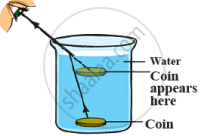
Why does a ray of light bend when it travels from one medium to another?
The refractive index of a transparent medium is always greater than ______.
Light bends as it passes from one medium to another. What is this phenomenon called?
A ray of light traveling in medium 1 strikes and travels into another transparent medium 2. If the speed of light is greater in medium 1, the ray will ______.
Assertion: The air bubble shines in water.
Reason: Air bubble shines due to the refraction of light.
How do twinkling stars occur? (or) what is the cause of the twinkling of stars?
In refraction of light through a glass slab, the directions of the incident ray and the refracted ray are ______.
When a ray of light travels normal to the given surface, then the angle of refraction is ______.
The part of light that enters into the other medium and travels in a straight path but in a direction different from its initial direction is called:
When light travels from a rarer medium to a denser medium, its speed:
According to the first law of refraction, the incident ray, the refracted ray, and the normal at the point of incidence:
The constant \[\frac{\sin i}{\sin r}\] for a given pair of media is called the:
A medium with a higher refractive index is:
