Advertisements
Advertisements
Question
Write scientific reason.
A pencil appears to be broken near the surface of water.
Advertisements
Solution
- When one look at the portion of the pencil that is inside the water, light travels from water to air via glass.
- This light ray changes the medium and undergoes refraction.
- As a result, the pencil inside the water appears to be broken near the surface of water.
APPEARS IN
RELATED QUESTIONS
| Column I | Column II | Column III | |
| 1 | Dispersion | Long-sightedness | Twinkling of stars |
| 2 | Refraction | Splitting of white light into component colours | Convex lens |
| 3 | Hypermetropia | Change in the direction of the ray of light due to change in medium | Spectrum of seven colours |
Name the phenomenon responsible for the following effect:
When we sit in front of a plane mirror and write with our right hand, it appears in the mirror that we are writing with the left hand.
Which property of light makes a pencil cast a shadow when it is held in front of a light source?
What is lateral inversion? Explain by giving a suitable example.
What are the important differences between looking at a photograph of your face and looking at yourself in a plane mirror?
A boy with a mouth 5 cm wide stands 2 m away from a plane mirror. Where is his image and how wide is the image of his mouth?
The boy walks towards the mirror at a speed of 1 m/s. At what speed does his image approach him?
State and explain the laws of reflection of light at a plane surface (like a plane mirror), With the help of a labelled ray-diagram. Mark the angles of 'incidence' and 'reflection' clearly on the diagram. If the angle of reflection is 47.5°, what will be the angle of incidence?
An object is placed 20 cm in front of a plane mirror. The mirror is moved 2 cm towards the object. The distance between the positions of the positions of the original and final images seen in the mirror is ______.
What is meant by the ‘angle of incidence’ for a ray of light?
Show the lateral displacement of the ray on the diagram.
Light travels at a lower speed in water than in air.
Air is optically .......... than glass.
When a ray of light travels from water to air, it bends ............. the normal.
When a ray of light travels from air to glass, it bends .......... the normal.
A ray of light A incident from air suffers partial reflection and refraction at the boundary of water.
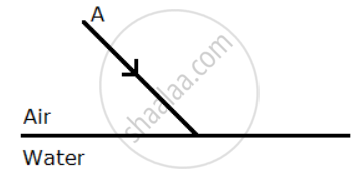
- Complete the diagram showing (i) the reflected ray B and (ii) the refracted ray C.
- How are the angles of incidence i and refraction r related?
A small air bubble in a glass block when seen from above appears to be raised because of ______.
Choose and write the correct option.
If we gradually increase the angle of incidence of a ray of light passing through prism then …..
List in proper sequence the steps of the experiment for determining the approximate focal length of a given concave mirror by obtaining the image of a distant object.
Explain the working of a periscope.
State whether true or false. If false, correct the statement.
The angle of deviation depends on the refractive index of the glass.
Why does a ray of light bend when it travels from one medium to another?
The deviation of light ray from its path when it travels from one transparent medium to another transparent medium is called ______.
If a beam of red light and a beam of violet light are incident at the same angle on the inclined surface of a prism from air medium and produce angles of refraction r and v respectively, which of the following is correct?

The angle of incidence from air to glass at the point O on the hemispherical glass slab is.
How does the light travel?
Light bends as it passes from one medium to another. What is this phenomenon called?
Light is refracted or bent while going from one medium to another because of its ______ changes.
Twinkling of stars and Mirage are the two phenomena occurring due to refraction.
Why a pencil partly immersed in water appears to be bent at the water surface.
The bottom of swimming pool appears to be less deep than the actual one because of
When light travels from a rarer medium to a denser medium, its speed:
When a ray of light is incident along the normal on the surface separating two media:
A medium with a higher refractive index is:
