Advertisements
Advertisements
Question
A ray of light A incident from air suffers partial reflection and refraction at the boundary of water.
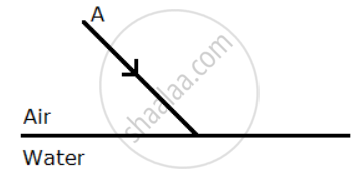
- Complete the diagram showing (i) the reflected ray B and (ii) the refracted ray C.
- How are the angles of incidence i and refraction r related?
Advertisements
Solution
- It shows the refracted beam DC and the reflected ray DB.

- `sin i/sin r = μ` is the relation.
APPEARS IN
RELATED QUESTIONS
State whether the following statement is true of false:
A student says that we can see an object because light from our eyes is reflected back by the object.
Which type of reflection of light leads to the formation of images?
A vertical ray of light strikes the horizontal surface of some water:
What is the angle of refraction?
Draw suitable diagrams to illustrate how a beam of light incident parallel to the principal axis is reflected by:
(a) a concave mirror, and (b) a convex mirror
A small air bubble in a glass block when seen from above appears to be raised because of ______.
Light enters from air to glass having refractive index 1.50. What is the speed of light in the glass? The speed of light in vacuum is 3 × 10⁸ m s−1.
The size of image of an object by a convex lens of focal length 20 cm is observed to be reduced to `1/3` rd of its size . Find the distance of the object from the optical centre of the lens .
Observe the given figure and name the following.
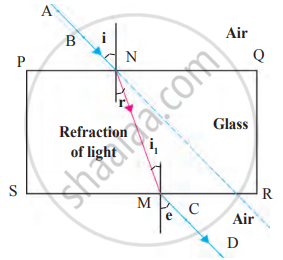
| Ray AB | |
| Ray NM | |
| Ray MD | |
| ∠ r |
Numerical problems.
The speed of light in water is 2.25 × 10⁸ ms–1. If the speed of light in vacuum is 3 × 10⁸ ms–1, calculate the refractive index of water.
Twinkling of stars and Mirage are the two phenomena occurring due to refraction.
