Advertisements
Advertisements
Question
Numerical problems.
The speed of light in water is 2.25 × 10⁸ ms–1. If the speed of light in vacuum is 3 × 10⁸ ms–1, calculate the refractive index of water.
Advertisements
Solution
Given: Speed of light in water (υ) = 2.25 × 10⁸ms– 1
Speed of light in vacuum (c) = 3 × 10⁸ms– 1
Solution:
μ = `"c"/"υ"` ⇒ μ =`(3×10^8"ms"^(−1))/(2.25×10^8"ms"^(−1))`
∴ μ = 1.33
APPEARS IN
RELATED QUESTIONS
Write the word AMBULANCE as it would appear when reflected in a plane mirror. Why is it sometimes written in this way (as its mirror image) on the front of an ambulance?
What is meant by 'reflection of light'?
When a light ray passes from air into glass, what happens to its speed? Draw a diagram to show which way the ray of light bends.
Lights of different colours are used as signal for safety transport. From these, the wavelength of red light is _______ nm.
Observe the given figure and name the following.
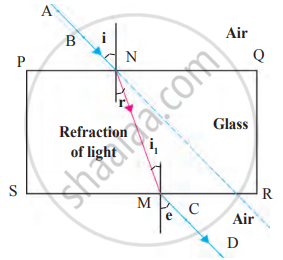
| Ray AB | |
| Ray NM | |
| Ray MD | |
| ∠ r |
Which object use the reflection of light?
Assertion: The air bubble shines in water.
Reason: Air bubble shines due to the refraction of light.
The ray that enters the second medium after crossing the boundary is called the:
Which of the following relations is called Snell's Law?
A larger refractive index of a medium means that light travels:
