Advertisements
Advertisements
Question
Name the phenomenon responsible for the following effect:
When we sit in front of a plane mirror and write with our right hand, if appears in the mirror that we are writing with the left hand.
Advertisements
Solution
The phenomenon of lateral inversion is the reason for the given effect.
APPEARS IN
RELATED QUESTIONS
Fill in the following blank with a suitable word:
When light is reflected, the angles of incidence and reflection are ............ .
Explain why, though both a plane mirror and a sheet of paper reflect light but we can see the image of our face in a plane mirror but not in a sheet of paper.
The angle of reflection is equal to the angle of incidence:
(a) always
(b) sometimes
(c) under special conditions
(d) never
As light rays pass from water into glass, are they refracted towards the normal or away from the normal?
Which phenomenon of light makes the water to appear shallower than it really is?
Fill in the following blank with suitable word:
Light bends when is passes from water into air. We say that it is ............
A ray of light travelling in air is incident on a rectangular glass block and emerges out into the air from the opposite face. Draw a labelled ray diagram to show the completer path of this ray of light. Mark the two points where the refraction of light takes place. What can you say about the final direction of ray of light?
With the help of a diagram, show how when light falls obliquely on the side of a rectangular glass slab, the emergent ray is parallel to the incident ray.
A ray of light passes from a medium X to another medium Y. No refraction of light occurs if the ray of light hits the boundary of medium Y at an angle of:
(a) 0°
(b) 45°
(c) 90°
(d) 120°
A vertical ray of light strikes the horizontal surface of some water:
What is the angle of incidence?
Image is formed by a mirror due to refraction of light.
What is the cause of refraction of light when it passes from one medium to another?
Define the principal focus of a concave mirror.
List four characteristics of the image formed by a concave lens of focal length 20 cm when the object is placed at a distance of 40 cm from its optical centre.
Lights of different colours are used as signal for safety transport. From these, the wavelength of red light is _______ nm.
The incident rays and refracting rays are on opposite sides of the normal.
Observe the given figure and write appropriate phenomenon of light in the box.
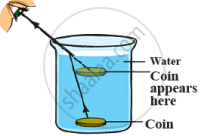
Explain with diagrams how refraction of incident light takes place from
- rarer to denser medium
- denser to rarer medium
- normal to the surface separating the two media.
Match the following:
| Column I | Column II | ||
| 1. | r > 90 | a. | Light gazes at the surface of separation between the two modes. |
| 2. | r = 90 | b. | No refraction. |
| 3. | r < 90 | c. | Refracted ray away from the normal |
In refraction of light through a glass slab, the directions of the incident ray and the refracted ray are ______.
