Advertisements
Advertisements
Question
With the help of a diagram, show how when light falls obliquely on the side of a rectangular glass slab, the emergent ray is parallel to the incident ray.
Advertisements
Solution
In the following figure, a light ray travelling in air is incident on the rectangular glass slab. It gets refracted and bends towards the normal. Again, a change in the direction takes place when the refracted ray travelling in glass emerges into air. Here, the light ray bends away from the normal. We see that the incident and emergent rays are parallel to each other. These rays are parallel because the extent of bending on the opposite and parallel faces of slab is equal and opposite.

APPEARS IN
RELATED QUESTIONS
A wall reflects light and a mirror also reflects light. What difference is three in the way they reflect light?
What is meant by 'reflection of light'?
Define the following terms used in the study of reflection of light by drawing a labelled ray-diagram:
(a) Incident ray
(b) Point of incidence
(c) Normal
(d) Reflected ray
(e) Angle of incidence
(f) Angle of reflection
With the help of a labelled ray-diagram, describe how a plane mirror forms an image of a point source of light placed in front of it. State the characteristics of the image formed in a plane mirror.
Write all the capital letters of the alphabet which look the same in a plane mirror.
A ray of light strikes a plane mirror PQ at an angle of incidence of 30°, is reflected from the plane mirror and then strikes a second plane mirror QR placed at right angles to the first mirror. The angle of reflection at the second mirror is ______.
A ray of light goes from water into air. Will it bend towards the normal or away from the normal?
In which material do you think light rays travel faster-glass or air?
What is meant by 'refraction of light'? Draw a labelled ray diagram to show the refraction of light.
When a light ray passes from air into glass, what happens to its speed? Draw a diagram to show which way the ray of light bends.
How does the light have to enter the glass:
for no refraction to happen?
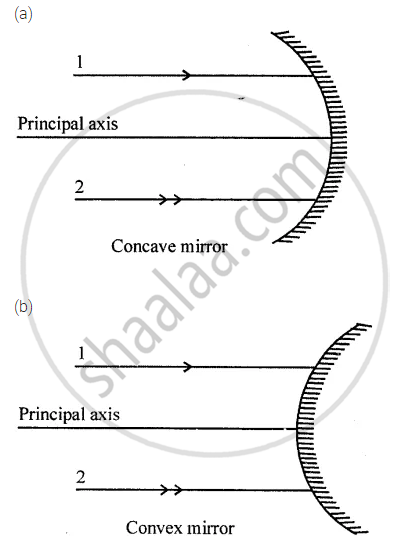
Draw suitable diagrams to illustrate how a beam of light incident parallel to the principal axis is reflected by:
(a) a concave mirror, and (b) a convex mirror
The diagram (figure) given below shows two parallel rays 1 and 2 incident on (a) a concave mirror, (b) a convex mirror. Draw the reflected rays and mark the focus by the symbol F.
Light enters from air to glass having refractive index 1.50. What is the speed of light in the glass? The speed of light in vacuum is 3 × 10⁸ m s−1.
What is atmospheric reflection? Explain with the help of a labelled diagram that the position of a star as seen by us is not its true position.
Explain how the formation of a rainbow occurs.
Lights of different colours are used as signal for safety transport. From these, the wavelength of red light is _______ nm.
Write scientific reason.
The bottom of a pond appears raised.
The refractive index of four substances A, B, C, and D are 1.31, 1.43, 1.33, 2.4 respectively. The speed of light is maximum in
How does the light travel?
