Advertisements
Advertisements
प्रश्न
With the help of a diagram, show how when light falls obliquely on the side of a rectangular glass slab, the emergent ray is parallel to the incident ray.
Advertisements
उत्तर
In the following figure, a light ray travelling in air is incident on the rectangular glass slab. It gets refracted and bends towards the normal. Again, a change in the direction takes place when the refracted ray travelling in glass emerges into air. Here, the light ray bends away from the normal. We see that the incident and emergent rays are parallel to each other. These rays are parallel because the extent of bending on the opposite and parallel faces of slab is equal and opposite.

APPEARS IN
संबंधित प्रश्न
State and explain the laws of reflection of light at a plane surface (like a plane mirror), With the help of a labelled ray-diagram. Mark the angles of 'incidence' and 'reflection' clearly on the diagram. If the angle of reflection is 47.5°, what will be the angle of incidence?
With the help of a labelled ray-diagram, describe how a plane mirror forms an image of a point source of light placed in front of it. State the characteristics of the image formed in a plane mirror.
A ray of light goes from water into air. Will it bend towards the normal or away from the normal?
In which material do you think light rays travel faster-glass or air?
How does the light have to enter the glass:
to produce a large amount of bending?
When a ray of light travels from water to air, it bends ............. the normal.
When a ray of light travels from air to glass, it bends .......... the normal.
What do you understand by refraction of light?
A ray of light A incident from air suffers partial reflection and refraction at the boundary of water.
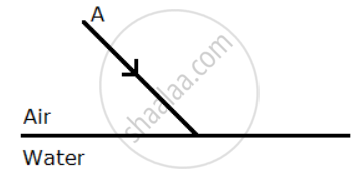
- Complete the diagram showing (i) the reflected ray B and (ii) the refracted ray C.
- How are the angles of incidence i and refraction r related?
Light enters from air to glass having refractive index 1.50. What is the speed of light in the glass? The speed of light in vacuum is 3 × 10⁸ m s−1.
Explain the working of a periscope.
Why does a ray of light bend when it travels from one medium to another?

The angle of incidence from air to glass at the point O on the hemispherical glass slab is.
Which object use the reflection of light?
Light travels fastest in a vacuum. Why?
A ray of light traveling in medium 1 strikes and travels into another transparent medium 2. If the speed of light is greater in medium 1, the ray will ______.
A water tank appears shallower when it is viewed from the top due to refraction.
Under what circumstances there won’t be any refraction of light when it enters from one medium to another?
