Advertisements
Advertisements
प्रश्न
How does the light have to enter the glass:
to produce a large amount of bending?
Advertisements
उत्तर
To produce a large amount of bending, the light ray has to enter the glass with a large angle of incidence.
APPEARS IN
संबंधित प्रश्न
State whether the following statement is true of false:
A student says that we can see an object because light from our eyes is reflected back by the object.
Write all the capital letters of the alphabet which look the same in a plane mirror.
A ray of light strikes a plane mirror PQ at an angle of incidence of 30°, is reflected from the plane mirror and then strikes a second plane mirror QR placed at right angles to the first mirror. The angle of reflection at the second mirror is ______.
If a ray of light goes from a rarer medium to a denser medium, will it bend towards the normal or away from it?
Name the phenomenon due to which a swimming pool appears less deep than it really is.
As light rays pass from water into glass, are they refracted towards the normal or away from the normal?
A ray of light A incident from air suffers partial reflection and refraction at the boundary of water.
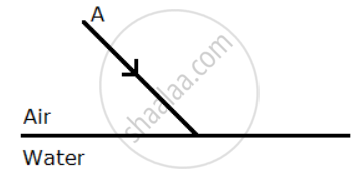
- Complete the diagram showing (i) the reflected ray B and (ii) the refracted ray C.
- How are the angles of incidence i and refraction r related?
Choose and write the correct option.
If we gradually increase the angle of incidence of a ray of light passing through prism then …..
Identify the wrong figure from the following.
Explain with diagrams how refraction of incident light takes place from
- rarer to denser medium
- denser to rarer medium
- normal to the surface separating the two media.
What is refractive index?
A pencil when dipped in water in a glass tumbler appears to be bent at the interface of air and water. Will the pencil appear to be bent to the same extent, if instead of water we use liquids like, kerosene or turpentine. Support your answer with reason.
A ray of light traveling in medium 1 strikes and travels into another transparent medium 2. If the speed of light is greater in medium 1, the ray will ______.
A water tank appears shallower when it is viewed from the top due to refraction.
Twinkling of stars and Mirage are the two phenomena occurring due to refraction.
When a ray of light is incident along the normal on the surface separating two media:
The absolute refractive index of a medium is given by:
A medium with a higher refractive index is:
