Advertisements
Advertisements
Question
Define the following terms used in the study of reflection of light by drawing a labelled ray-diagram:
(a) Incident ray
(b) Point of incidence
(c) Normal
(d) Reflected ray
(e) Angle of incidence
(f) Angle of reflection
Advertisements
Solution
(a) Incident ray: The ray of light that falls on a mirror is called the incident ray. In the figure, AO is the incident ray of light. The incident ray gives the direction of the light falling on the mirror.
(b) Point of incidence: The point at which the incident ray falls on a mirror is called the point of incidence. In the figure, the point O on the surface of the mirror is the point of incidence.
(c) Normal: The normal is a line at right angles to the mirror surface at the point of incidence. In the figure, the line ON is the normal to the mirror surface at point O.
(d) Reflected ray: The ray of light that is sent back by the mirror is called the reflected ray. In the figure, OB is the reflected ray of light. The reflected ray of light shows the direction in which the light travels after being reflected from the mirror.
(e) Angle of incidence: The angle of incidence is the angle made by the incident ray with the normal at the point of incidence. In the figure, the angle AON is the angle of incidence. The angle of incidence is denoted by the letter i.
(f) Angle of reflection: The angle of reflection is the angle made by the reflected ray with the normal at the point of incidence. In the figure, the angle NOB is the angle of reflection. The angle of reflection is denoted by the letter r .
APPEARS IN
RELATED QUESTIONS
Write the word AMBULANCE as it would appear when reflected in a plane mirror. Why is it sometimes written in this way (as its mirror image) on the front of an ambulance?
What are the important differences between looking at a photograph of your face and looking at yourself in a plane mirror?
The figure given alongside shows the image of a clock as seen a plane mirror. The correct time is:
Figure
(a) 2.25
(b) 2.35
(c) 6.45
(d) 9.25
A man stands 10 m in front of a large plane mirror. How far must the walk before he is 5 m away from his image?
An object is placed 20 cm in front of a plane mirror. The mirror is moved 2 cm towards the object. The distance between the positions of the positions of the original and final images seen in the mirror is ______.
Light travels more quickly through water than through glass.
Which is optically denser : water or glass?
Name the phenomenon due to which a pencil partly immersed in water and held obliquely appears to be bent at the water surface.
When a ray of light travels from water to air, it bends ............. the normal.
When a ray of light travels from air to glass, it bends .......... the normal.
Define the principal focus of a concave mirror.
List in proper sequence the steps of the experiment for determining the approximate focal length of a given concave mirror by obtaining the image of a distant object.
Write scientific reason.
The bottom of a pond appears raised.
Observe the given figure and name the following.
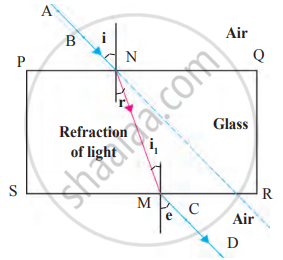
| Ray AB | |
| Ray NM | |
| Ray MD | |
| ∠ r |
The refractive index of four substances A, B, C, and D are 1.31, 1.43, 1.33, 2.4 respectively. The speed of light is maximum in
If a beam of red light and a beam of violet light are incident at the same angle on the inclined surface of a prism from air medium and produce angles of refraction r and v respectively, which of the following is correct?
A ray of light traveling in medium 1 strikes and travels into another transparent medium 2. If the speed of light is greater in medium 1, the ray will ______.
The ratio of the sine of the angle of incidence to the sine of ______ is constant.
Mirage is an example of refraction and the total internal reflection of light.
Which is optically denser out of the two medium M1& M2 having the refractive indices = 1.71 and 1.36 respectively?
How do twinkling stars occur? (or) what is the cause of the twinkling of stars?
