Advertisements
Advertisements
प्रश्न
Define the following terms used in the study of reflection of light by drawing a labelled ray-diagram:
(a) Incident ray
(b) Point of incidence
(c) Normal
(d) Reflected ray
(e) Angle of incidence
(f) Angle of reflection
Advertisements
उत्तर
(a) Incident ray: The ray of light that falls on a mirror is called the incident ray. In the figure, AO is the incident ray of light. The incident ray gives the direction of the light falling on the mirror.
(b) Point of incidence: The point at which the incident ray falls on a mirror is called the point of incidence. In the figure, the point O on the surface of the mirror is the point of incidence.
(c) Normal: The normal is a line at right angles to the mirror surface at the point of incidence. In the figure, the line ON is the normal to the mirror surface at point O.
(d) Reflected ray: The ray of light that is sent back by the mirror is called the reflected ray. In the figure, OB is the reflected ray of light. The reflected ray of light shows the direction in which the light travels after being reflected from the mirror.
(e) Angle of incidence: The angle of incidence is the angle made by the incident ray with the normal at the point of incidence. In the figure, the angle AON is the angle of incidence. The angle of incidence is denoted by the letter i.
(f) Angle of reflection: The angle of reflection is the angle made by the reflected ray with the normal at the point of incidence. In the figure, the angle NOB is the angle of reflection. The angle of reflection is denoted by the letter r .
APPEARS IN
संबंधित प्रश्न
Write the word AMBULANCE as it would appear when reflected in a plane mirror. Why is it sometimes written in this way (as its mirror image) on the front of an ambulance?
Which type of reflection of light leads to the formation of images?
The angle of reflection is equal to the angle of incidence:
(a) always
(b) sometimes
(c) under special conditions
(d) never
The figure given alongside shows the image of a clock as seen a plane mirror. The correct time is:
Figure
(a) 2.25
(b) 2.35
(c) 6.45
(d) 9.25
State two effects caused by the refraction of light.
Name the phenomenon due to which a swimming pool appears less deep than it really is.
A coin in a glass tumbler appears to rise as the glass tumbler is slowly filled with water. Name the phenomenon responsible for this effect.
When a ray of light travels from air to glass, it bends .......... the normal.
What do you understand by refraction of light?
A ray of light A incident from air suffers partial reflection and refraction at the boundary of water.
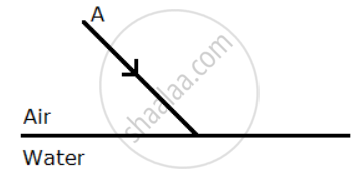
- Complete the diagram showing (i) the reflected ray B and (ii) the refracted ray C.
- How are the angles of incidence i and refraction r related?
What is atmospheric reflection? Explain with the help of a labelled diagram that the position of a star as seen by us is not its true position.
List in proper sequence the steps of the experiment for determining the approximate focal length of a given concave mirror by obtaining the image of a distant object.
Why does a ray of light bend when it travels from one medium to another?
Explain with diagrams how refraction of incident light takes place from
- rarer to denser medium
- denser to rarer medium
- normal to the surface separating the two media.
What is refractive index?
The angle of incidence for a ray of light having zero reflection angle is ______.
Light travels fastest in a vacuum. Why?
The ratio of the sine of the angle of incidence to the sine of ______ is constant.
How do twinkling stars occur? (or) what is the cause of the twinkling of stars?
In refraction of light through a glass slab, the directions of the incident ray and the refracted ray are ______.
