Advertisements
Advertisements
प्रश्न
A coin in a glass tumbler appears to rise as the glass tumbler is slowly filled with water. Name the phenomenon responsible for this effect.
Advertisements
उत्तर
A coin in a glass tumbler appears to rise as the glass tumbler is slowly filled with water. It occurs because of refraction.
APPEARS IN
संबंधित प्रश्न
Where is the image when you look at something in a mirror?
The image of an object formed by a plane mirror is:
(a) virtual
(b) real
(c) diminished
(d) upside-down
The image formed by a plane mirror is :
(a) virtual, behind the mirror and enlarged.
(b) virtual, behind the mirror and of the same size as the object.
(c) real, at the surface of the mirror and enlarged.
(d) real, behind the mirror and of the same size as the object.
The figure given alongside shows the image of a clock as seen a plane mirror. The correct time is:
Figure
(a) 2.25
(b) 2.35
(c) 6.45
(d) 9.25
If a ray of light goes from a rarer medium to a denser medium, will it bend towards the normal or away from it?
As light rays pass from water into glass, are they refracted towards the normal or away from the normal?
Light travels more quickly through water than through glass.
Which is optically denser : water or glass?
Light travelling from a denser medium to a rarer medium along a normal to the boundary:
(a) is refracted towards the normal
(b) is refracted away from the normal
(c) goes along the boundary
(d) is not refracted
A ray of light passes from a medium X to another medium Y. No refraction of light occurs if the ray of light hits the boundary of medium Y at an angle of:
(a) 0°
(b) 45°
(c) 90°
(d) 120°
Draw a diagram showing the refraction of a light ray from water to glass. Label on it the incident ray, the angle of incidence (/), and the angle of refraction (r)
Define the principal focus of a concave mirror.
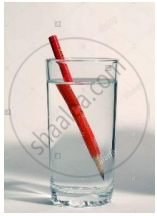
Due to _______ pencil looks bent in water, in the given experiment.
Assertion and reasoning type
- Assertion: If the refractive index of the medium is high (denser medium) the velocity of the light in that medium will be small
- Reason: Refractive index of the medium is inversely proportional to the velocity of the light
The deviation of light ray from its path when it travels from one transparent medium to another transparent medium is called ______.
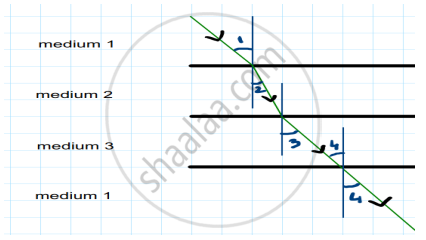
In the above diagram light is travelling through different media. It is noted by a scientist that ∠1= ∠3 = ∠4 but ∠2 < ∠1. Which of the following statement would be correct?
Which object use the reflection of light?
When light passes from one medium to another the ray gets bent. This property of light is called ______.
How does the light travel?
Match the following:
| Column I | Column II | ||
| 1. | r > 90 | a. | Light gazes at the surface of separation between the two modes. |
| 2. | r = 90 | b. | No refraction. |
| 3. | r < 90 | c. | Refracted ray away from the normal |
When a ray of light travels normal to the given surface, then the angle of refraction is ______.
