Advertisements
Advertisements
प्रश्न
Due to _______ pencil looks bent in water, in the given experiment.
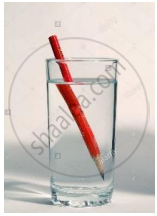
पर्याय
refraction of light
dispersion of light
internal reflection of light
reflection of light
Advertisements
उत्तर
Due to refraction of light pencil looks bent in water, in the given experiment.
APPEARS IN
संबंधित प्रश्न
If an object is placed at a distance of 10 cm in from of a plane mirror, how far would it be from its image?
State whether the following statement is true of false:
A student says that we can see an object because light from our eyes is reflected back by the object.
A wall reflects light and a mirror also reflects light. What difference is three in the way they reflect light?
What is meant by 'reflection of light'?
A man stands 10 m in front of a large plane mirror. How far must the walk before he is 5 m away from his image?
State two effects caused by the refraction of light.
A ray of light passes from air into a block of glass. Does it bend towards the normal or away from it?
State whether the following statement is true or false:
Refraction occurs because light slows down in denser materials.
Why does a ray of light bend when it travels from one medium to another?
What is meant by ‘refraction of light’?
Light travels more quickly through water than through glass.
- Which is optically denser: water or glass?
- If a ray of light passes from glass into water, which way will it bend: towards the normal or away from the normal?
Name the phenomenon due to which a pencil partly immersed in water and held obliquely appears to be bent at the water surface.
A vertical ray of light strikes the horizontal surface of some water:
What is the angle of refraction?
How does the light have to enter the glass:
to produce a large amount of bending?
Light travels at a lower speed in water than in air.
Water is optically .......... than air.
Air is optically .......... than glass.
Draw a diagram showing the refraction of a light ray from water to glass. Label on it the incident ray, the angle of incidence (/), and the angle of refraction (r)
Draw suitable diagrams to illustrate how a beam of light incident parallel to the principal axis is reflected by:
(a) a concave mirror, and (b) a convex mirror
A light ray suffers reflection and refraction at the boundary in passing from air to water. Draw a neat labelled ray diagram to show it.
A ray of light A incident from air suffers partial reflection and refraction at the boundary of water.
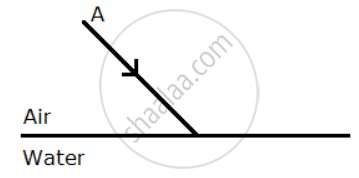
- Complete the diagram showing (i) the reflected ray B and (ii) the refracted ray C.
- How are the angles of incidence i and refraction r related?
List four characteristics of the image formed by a concave lens of focal length 20 cm when the object is placed at a distance of 40 cm from its optical centre.
Explain how the formation of a rainbow occurs.
The laws of reflection hold true for ______.
Identify the wrong figure from the following.
The speed of light varies in different media.
Assertion and reasoning type
- Assertion: If the refractive index of the medium is high (denser medium) the velocity of the light in that medium will be small
- Reason: Refractive index of the medium is inversely proportional to the velocity of the light
The deviation of light ray from its path when it travels from one transparent medium to another transparent medium is called ______.
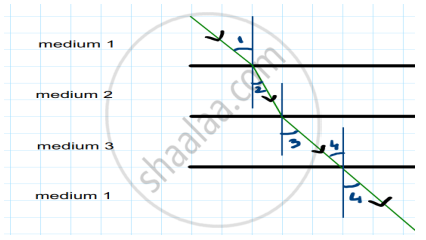
In the above diagram light is travelling through different media. It is noted by a scientist that ∠1= ∠3 = ∠4 but ∠2 < ∠1. Which of the following statement would be correct?
The phenomenon of light passing through the object is called ______.
A star appears twinkling into the sky because of the reflection of light by the atmosphere.
Which is optically denser out of the two medium M1& M2 having the refractive indices = 1.71 and 1.36 respectively?
In refraction of light through a glass slab, the directions of the incident ray and the refracted ray are ______.
A ray of light starting from diamond is incident on the interface separating diamond and water. Draw a labelled ray diagram to show. the refraction of light in this case.
The change in the direction of the path of light when it passes from one transparent medium to another transparent medium is called:
When a ray of light is incident along the normal on the surface separating two media:
According to the second law of refraction, for a given pair of media, the ratio of the sine of the angle of incidence to the sine of the angle of refraction:
Which of the following relations is called Snell's Law?
