Advertisements
Advertisements
प्रश्न
A vertical ray of light strikes the horizontal surface of some water:
What is the angle of refraction?
Advertisements
उत्तर
If the incident ray falls normally on the surface, no bending of light ray takes place. So, the angle of refraction is also `0^0`
संबंधित प्रश्न
Define the following terms used in the study of reflection of light by drawing a labelled ray-diagram:
- Incident ray
- Point of incidence
- Normal
- Reflected ray
- Angle of incidence
- Angle of reflection
The angle of reflection is equal to the angle of incidence:
(a) always
(b) sometimes
(c) under special conditions
(d) never
If a ray of light goes from a rarer medium to a denser medium, will it bend towards the normal or away from it?
As light rays pass from water into glass, are they refracted towards the normal or away from the normal?
Why does a ray of light bend when it travels from one medium to another?
A ray of light travelling in air is incident on a rectangular glass block and emerges out into the air from the opposite face. Draw a labelled ray diagram to show the completer path of this ray of light. Mark the two points where the refraction of light takes place. What can you say about the final direction of ray of light?
What is meant by the ‘angle of incidence’ for a ray of light?
Light travels more quickly through water than through glass.
If a ray of light passes from glass into water, which way will it bend : towards the normal or away from the normal?
Light travelling from a denser medium to a rarer medium along a normal to the boundary:
(a) is refracted towards the normal
(b) is refracted away from the normal
(c) goes along the boundary
(d) is not refracted
Draw suitable diagrams to illustrate how a beam of light incident parallel to the principal axis is reflected by:
(a) a concave mirror, and (b) a convex mirror
A ray of light A incident from air suffers partial reflection and refraction at the boundary of water.
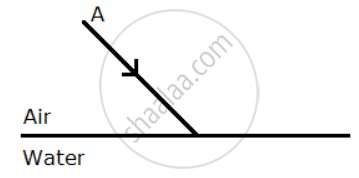
- Complete the diagram showing (i) the reflected ray B and (ii) the refracted ray C.
- How are the angles of incidence i and refraction r related?
We can see the sun even when it is little below the horizon because of ______.
Define the principal focus of a concave mirror.
Light enters from air to glass having refractive index 1.50. What is the speed of light in the glass? The speed of light in vacuum is 3 × 10⁸ m s−1.
Explain how the formation of a rainbow occurs.
A real image is formed by the light rays after reflection or refraction when they:
- actually meet or intersect with each other.
- actually converge at a point.
- appear to meet when they are produced in the backward direction.
- appear to diverge from a point.
Which of the above statements are correct?
Write a scientific reason.
The coin disappears in a vessel as it is seen from a specific location. But as soon as the water is poured into the vessel to a certain level, the coin appears.
Under what circumstances there won’t be any refraction of light when it enters from one medium to another?
How do twinkling stars occur? (or) what is the cause of the twinkling of stars?
A normal is an imaginary line drawn ________ to the boundary at the point of incidence.
