Advertisements
Advertisements
प्रश्न
Draw suitable diagrams to illustrate how a beam of light incident parallel to the principal axis is reflected by:
(a) a concave mirror, and (b) a convex mirror
Advertisements
उत्तर
(a) Concave mirror
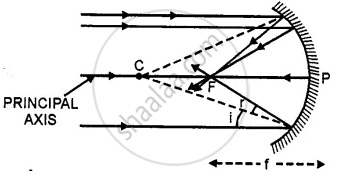
(b) Convex mirror

APPEARS IN
संबंधित प्रश्न
A wall reflects light and a mirror also reflects light. What difference is three in the way they reflect light?
Show the lateral displacement of the ray on the diagram.
A ray of light when passes from glass to air, bends towards the normal.
When a ray of light travels from air to glass, it bends .......... the normal.
What is atmospheric reflection? Explain with the help of a labelled diagram that the position of a star as seen by us is not its true position.
The refractive index of a transparent medium is always greater than ______.
Which is optically denser out of the two medium M1& M2 having the refractive indices = 1.71 and 1.36 respectively?
When light passes from one transparent medium to another, its direction changes due to:
When light travels from a rarer medium to a denser medium, its speed:
When light travels from a denser medium to a rarer medium, its speed:
