Advertisements
Advertisements
प्रश्न
List four characteristics of the image formed by a concave lens of focal length 20 cm when the object is placed at a distance of 40 cm from its optical centre.
Advertisements
उत्तर
Characteristics of the image formed by a concave lens :
According to sign convensions :
`f = 20 "cm"` ; `u = -40 "cm"`
we know that ,
`-1/f = -1/"v" - 1/u`
`therefore 1/"v" = 1/f - 1/u = 1/20 - 1/40 = 20/800`
`therefore 1/"v" = 1/40`
`therefore "v" = 40 "cm"`
(i) image will be formed at 40 cm from the optical centre.
(ii) Radius of curvature of lens :
`R = -2f ∴ R = -2 xx 20 = -40 "cm"`
(iii) Since image distance is positive, therefore image is virtual.
(iv) Image will be erect.
(v) Image will form opposite side of the lens.
APPEARS IN
संबंधित प्रश्न
Write all the capital letters of the alphabet which look the same in a plane mirror.
Fill in the following blank with suitable word:
Light travelling along a normal is ...............refracted.
Show the lateral displacement of the ray on the diagram.
A ray of light when passes from glass to air, bends towards the normal.
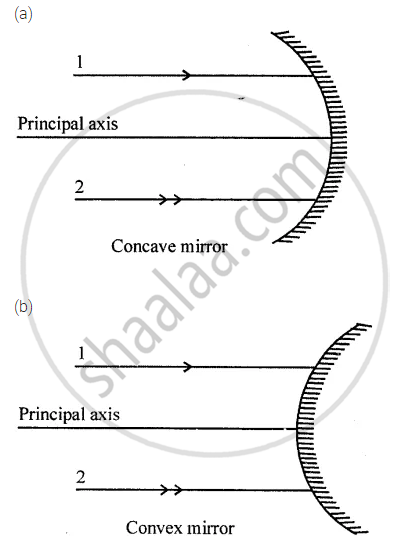
The diagram (figure) given below shows two parallel rays 1 and 2 incident on (a) a concave mirror, (b) a convex mirror. Draw the reflected rays and mark the focus by the symbol F.
A ray of light passes from medium 1 to medium 2. Which of the following quantities of the refracted ray will differ from that of the incident ray: Speed, intensity, frequency, wavelength?
If a beam of red light and a beam of violet light are incident at the same angle on the inclined surface of a prism from air medium and produce angles of refraction r and v respectively, which of the following is correct?
Light travels fastest in a vacuum. Why?
Assertion: The air bubble shines in water.
Reason: Air bubble shines due to the refraction of light.
When light travels from a denser medium to a rarer medium, its speed:
