Advertisements
Advertisements
प्रश्न
Define the following terms used in the study of reflection of light by drawing a labelled ray-diagram:
(a) Incident ray
(b) Point of incidence
(c) Normal
(d) Reflected ray
(e) Angle of incidence
(f) Angle of reflection
Advertisements
उत्तर
(a) Incident ray: The ray of light that falls on a mirror is called the incident ray. In the figure, AO is the incident ray of light. The incident ray gives the direction of the light falling on the mirror.
(b) Point of incidence: The point at which the incident ray falls on a mirror is called the point of incidence. In the figure, the point O on the surface of the mirror is the point of incidence.
(c) Normal: The normal is a line at right angles to the mirror surface at the point of incidence. In the figure, the line ON is the normal to the mirror surface at point O.
(d) Reflected ray: The ray of light that is sent back by the mirror is called the reflected ray. In the figure, OB is the reflected ray of light. The reflected ray of light shows the direction in which the light travels after being reflected from the mirror.
(e) Angle of incidence: The angle of incidence is the angle made by the incident ray with the normal at the point of incidence. In the figure, the angle AON is the angle of incidence. The angle of incidence is denoted by the letter i.
(f) Angle of reflection: The angle of reflection is the angle made by the reflected ray with the normal at the point of incidence. In the figure, the angle NOB is the angle of reflection. The angle of reflection is denoted by the letter r .
APPEARS IN
संबंधित प्रश्न
| Column I | Column II | Column III | |
| 1 | Dispersion | Long-sightedness | Twinkling of stars |
| 2 | Refraction | Splitting of white light into component colours | Convex lens |
| 3 | Hypermetropia | Change in the direction of the ray of light due to change in medium | Spectrum of seven colours |
A boy with a mouth 5 cm wide stands 2 m away from a plane mirror. Where is his image and how wide is the image of his mouth?
Explain how to read the following message which was found on some blotting paper:
If a ray of light goes from a rarer medium to a denser medium, will it bend towards the normal or away from it?
A ray of light goes from water into air. Will it bend towards the normal or away from the normal?
Fill in the following blank with suitable word:
Light travelling along a normal is ...............refracted.
Water is optically denser than glass.
The speed of light is more in glass than in water.
Light travels at a lower speed in water than in air.
A ray of light A incident from air suffers partial reflection and refraction at the boundary of water.
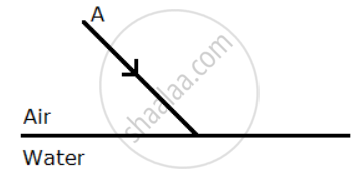
- Complete the diagram showing (i) the reflected ray B and (ii) the refracted ray C.
- How are the angles of incidence i and refraction r related?
We can see the sun even when it is little below the horizon because of ______.
The size of image of an object by a convex lens of focal length 20 cm is observed to be reduced to `1/3` rd of its size . Find the distance of the object from the optical centre of the lens .
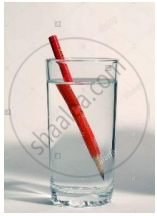
Due to _______ pencil looks bent in water, in the given experiment.
The incident rays and refracting rays are on opposite sides of the normal.
Write scientific reason.
A pencil appears to be broken near the surface of water.
The refractive index of four substances A, B, C, and D are 1.31, 1.43, 1.33, 2.4 respectively. The speed of light is maximum in
The ratio of the sine of the angle of incidence to the sine of ______ is constant.
Assertion: The air bubble shines in water.
Reason: Air bubble shines due to the refraction of light.
Why a pencil partly immersed in water appears to be bent at the water surface.
In refraction of light through a glass slab, the directions of the incident ray and the refracted ray are ______.
