Advertisements
Advertisements
प्रश्न
| Column I | Column II | Column III | |
| 1 | Dispersion | Long-sightedness | Twinkling of stars |
| 2 | Refraction | Splitting of white light into component colours | Convex lens |
| 3 | Hypermetropia | Change in the direction of the ray of light due to change in medium | Spectrum of seven colours |
Advertisements
उत्तर
| Column I | Column II | Column III | |
| 1 | Dispersion | Splitting of white light into component colours | Spectrum of seven colours |
| 2 | Refraction | Change in the direction of the ray of light due to change in medium | Twinkling of stars |
| 3 | Hypermetropia | Long-sightedness | Convex lens |
APPEARS IN
संबंधित प्रश्न
If an object is placed at a distance of 10 cm in from of a plane mirror, how far would it be from its image?
Which property of light makes a pencil cast a shadow when it is held in front of a light source?
State whether the following statement is true of false:
A student says that we can see an object because light from our eyes is reflected back by the object.
What is lateral inversion? Explain by giving a suitable example.
What type of reflection of light takes place from a cinema screen?
Write all the capital letters of the alphabet which look the same in a plane mirror.
The image formed by a plane mirror is :
(a) virtual, behind the mirror and enlarged.
(b) virtual, behind the mirror and of the same size as the object.
(c) real, at the surface of the mirror and enlarged.
(d) real, behind the mirror and of the same size as the object.
Explain how to read the following message which was found on some blotting paper:

A ray of light goes from water into air. Will it bend towards the normal or away from the normal?
Name the phenomenon due to which a swimming pool appears less deep than it really is.
What is meant by the ‘angle of incidence’ for a ray of light?
Light travels more quickly through water than through glass.
- Which is optically denser: water or glass?
- If a ray of light passes from glass into water, which way will it bend: towards the normal or away from the normal?
A coin in a glass tumbler appears to rise as the glass tumbler is slowly filled with water. Name the phenomenon responsible for this effect.
The depth of a pond when seen from above appears to be less.
Light travels at a lower speed in water than in air.
Image is formed by a mirror due to refraction of light.
Match the Following
| Column A | Column B |
| (a) white Light | (1) Convex mirror |
| (b) Refraction | (2) Concave mirror |
| (c) Virtual images | (3) refraction |
| (d) Real images | (4) spectrum |
| (e) Prism | (5) ray of light from glass to air |
Draw suitable diagrams to illustrate how a beam of light incident parallel to the principal axis is reflected by:
(a) a concave mirror, and (b) a convex mirror
A light ray suffers reflection and refraction at the boundary in passing from air to water. Draw a neat labelled ray diagram to show it.
The size of image of an object by a convex lens of focal length 20 cm is observed to be reduced to `1/3` rd of its size . Find the distance of the object from the optical centre of the lens .
Explain how the formation of a rainbow occurs.
Identify the wrong figure from the following.
Observe the given figure and name the following.
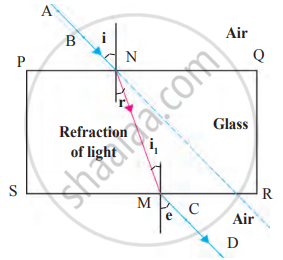
| Ray AB | |
| Ray NM | |
| Ray MD | |
| ∠ r |
Explain the working of a periscope.
Explain with diagrams how refraction of incident light takes place from
- rarer to denser medium
- denser to rarer medium
- normal to the surface separating the two media.
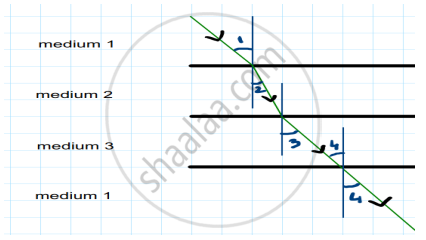
In the above diagram light is travelling through different media. It is noted by a scientist that ∠1= ∠3 = ∠4 but ∠2 < ∠1. Which of the following statement would be correct?
Light travels fastest in a vacuum. Why?
The bending of light as it passes from one medium to another is called ______.
Light is refracted or bent while going from one medium to another because of its ______ changes.
A star appears twinkling into the sky because of the reflection of light by the atmosphere.
Mirage is an example of refraction and the total internal reflection of light.
Which is optically denser out of the two medium M1& M2 having the refractive indices = 1.71 and 1.36 respectively?
Why a pencil partly immersed in water appears to be bent at the water surface.
The change in the direction of the path of light when it passes from one transparent medium to another transparent medium is called:
When light passes from one transparent medium to another, its direction changes due to:
When light travels from a rarer medium to a denser medium, its speed:
When a light ray passes from a denser medium to a rarer medium, it bends:
According to the first law of refraction, the incident ray, the refracted ray, and the normal at the point of incidence:
